|
|
|||

|

|
|

|
|
|
|||
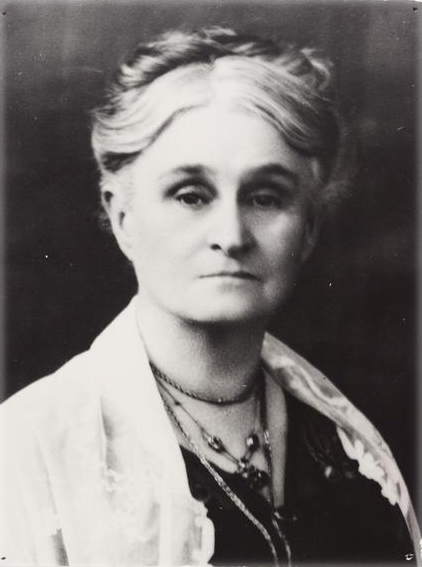
EDITH DIRCKSEY COWAN1861-1932
|
|
|
|
|
Edith Brown, daughter of Kenneth Brown (Maitland Brown's brother), was born near Geraldton on August 2 1861. Edith's mother was the daughter of Rev. J.B. Wittenoom.
Her mother (Mary Eliza Dircksey Wittenoom) died in childbirth in 1868 and Edith was placed in a boarding school operated be the Cowan Sisters.
When she was only 14 years old when her father shot dead her step-mother in 1876. Her father was executed for the crime and Edith's life long efforts to improve conditions for women may well have been triggered by this event.
Edith had three surviving siblings; Blanche, Forrest and Clarence and two half siblings from her father's second marriage; Rose and Amy.
In 1879 Edith married James Cowan, Registrar of the Supreme Court. The couple had 5 children, Dircksey Constance (1880), Norman Walkinshaw (1882), Hilda Edith (1883), Ida Marion (1885) and Helen May Burdett (1891).
|
|
Edith was a foundation member of the Women's Service Guilds and she worked tirelessly to improve the standing of women in the community.
Women won the right to sit in parliament in 1920 (the same year Edith was made a Justice of the Peace and awarded an OBE) and in 1921 Edith was elected to the seat of West Perth. This not only made her the first woman to be elected in W.A., she was in fact the first Australian born woman elected to any legislature in the British Empire and was second only to Lady Nancy Astor (born in Virginia USA) who was elected to the House of Commons in 1920.
Edith only decided to run for office just 4 weeks before the election and she defeated the sitting member, the Attorney General, who had been responsible for the bill allowing women to stand for parliament.
In 1923 Edith introduced the 'Women's Legal Status Bill' that was responsible for admitting women to professional careers.
Although she only served one term in office she went on working for social reform for the rest of her life.
She died in 1932. Edith Cowan University was named in her honour. The Clock Tower at the entrance to King's Park was built shortly after her death as a memorial and at that time it was the most significant civic memorial in Australia dedicated to a woman.
The Federal seat of Cowan is another tribute to Edith and her picture appears on the 50 dollar bill.
Premier James Mitchell wrote the following tribute to Edith Cowan:
"I have known Mrs. Cowan for many years, both before and after she entered political life and we shall all miss her very much. Mrs. Cowan gave her whole life for the good of other people and for the State in which she was born. Her work for the women of the community will long be remembered.
Although necessarily a large part of her life was spent in Perth, she was essentially just as interested in the welfare of the country people and traveled among them a good deal. During the war she was a tremendous worker for the Red Cross. She was a real success as the first woman member of the State Parliament because she was capable and experienced, level-headed and sympathetic. Her keen interest in women and her knowledge of the woman's point of view did not prevent her from an understanding of questions of a more general nature concerning the State, and nobody could have been more interested in its history. She had a will of her own, and whatever she took up it was with the intention of seeing it through.
I well remember that many early deputations representing women's interests which she led and the keen fight which she put up to have the law altered to allow women to sit in Parliament. She was a capable speaker, too, and her work as a Justice of the Peace, on the Children's Court Bench, among group settlers, and in other ways, showed her to have set an example which other women in Western Australia would do well to follow."
Chronology
1861 - Born on August 2nd. 1876 - Father executed for murder on June 10th. 1879 - Married James Cowan on November 12th. 1880 - Child born - Dircksey Constance . 1882 - Child born - Norman Walkinshaw. 1883 - Child born - Hilda Edith. 1885 - Child born - Ida Marion. 1891 - Child born - Helen May Burdett. 1891 - Worked for the Ministering Children's League. 1894 - Karrakatta Women's Club's first secretary. 1894 - Worked for the House of Mercy for unmarried mothers. 1903 - Travelled to Europe. 1906 - Foundation member of the Children's Protection Society. 1909 - Helped initiate the Women's Service Guild. 1911 - Worked to help form the Western Australian National Council of Women. 1912 - Travelled to Europe. 1915 - Appointed to the bench of the Children's Court. 1916 - Foundation member of Co-Freemasonry and first female member of the Anglican Social Questions Committee. 1920 - Became a Justice of the Peace and awarded an OBE. 1921 - Elected to the seat of West Perth. 1923 - Introduced the 'Women's Legal Status Bill'. 1924 - Stood for parliament again but was defeated. 1925 - Travelled to the USA as an Australian delegate to the sixth convention of the International Council 1926 - Founder of the Royal Western Australian Historical Society. 1927 - Stood for parliament again but was defeated. 1929 - Active in plans for the state's centenary celebrations. 1932 - Died June 9th.
Links to more information:
Cowan, Edith Dircksey (1861-1932) Cowan, Edith Dircksey, (OBE) (1861-1932)
|
|
|
Become a supporter of this website for just $5 a month
|