|
|
|||

|

|
|

|
|
|
|||
AFGHANS IN WESTERN AUSTRALIA
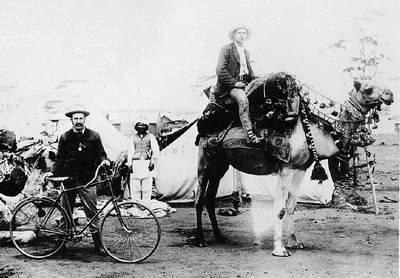
Historical picture of a camel and Afghan cameleer (background)
|
|
|
|
|
|
WE NEED YOUR SUPPORT. |
|


|
|
|
A word or two needs to be said about the importance of the Afghan camel drivers, who helped open up much of Western Australia (and indeed the rest of Australia as well) and who carted much needed supplies to the outback towns and stations.
Australia is 70% arid or semi-arid land and as a result it has the smallest population of all the world’s five continents. With so much desert to explore it comes as no surprise that camels and the men skilled in handling them were brought out to help open up the vast dry interior.
A high proportion of early settlers who came to Australia were ex-military men who had served in India. Here they had come into contact with camels and had seen the advantages they had over horses when travelling through areas of very low rainfall.
Although the word ‘Afghan’ is used as a universal description of the cameleers, their nationality varied considerably. They came from India, Pakistan, Iran, Turkey and of course Afghanistan. It is thought that the name Afghan stuck because the first cameleers and their camels arrived in South Australia aboard the ship Afghan.
The first camels brought to Australia were a single male and single female, shipped to Hobart in 1840. They were sent on to Melbourne and then Sydney but their ultimate fate remains unknown. Estimates put the number of Afghans that came out to Australia to act as cameleers to be around 3,000. What proportion of those came to W.A. is unknown.
The first camels to arrive in W.A. came with Ernest Giles in November 1875, after crossing the continent from Adelaide, but it was the discovery of gold in several centres that led to large numbers of Afghans and their camels making their way here.
It was on these same goldfields (supplied to a great extent by the cameleers) that racial tensions began to appear. Following are some excerpts from an article published in the Coolgardie Miner in June 1884:
'We calmly arise to protest in language simple and unadorned against the opening of our doors to aliens of Asiatic extraction... ...As a rule they are peaceful, obliging, industrious fellows, who interfere with no man's right;... ...Those Afghans who have pitched their tents amongst us seem a most exemplary lot of men... ...but we fear a low degenerate mongrel race of human beings will follow where they lead, and for the protection of our Anglo Saxon race we say and say emphatically... ...we have no use for you at present.'
Worse was to come and the same newspaper was responsible for publishing the following venomous diatribe:
'These Afghans, we are informed on unquestionable authority are well armed, and would have little hesitation in punctuating with bullets their objections to being interfered with. History furnishes us with vivid portrayals of the defilement of the dead women and children, and the awful horrors which have always followed even the temporary triumphs of the black man over the white, or the Moslem over the Christian.'
It just goes on getting worse and worse:
'The Asiatic has not come along in the march of civilisation as so far as to leave his instinct to kill behind him. When the Asiatic goes a little dotty; he runs amok, and strikes down all who come in his path.'
These articles were nothing more than incitement to public unrest and disorder.
As the Afghans were in competition with European haulers, who mostly used horses, there was some friction between the two groups. It was said that horses would baulk at drinking from wells where camels had been a short time before and that horses became nervous and skittish when camels were about.
One of the worst incidents to occur took place east of Esperance at a place now known as Afghan Rocks. Two parties, one with horses and one with camels, had camped near each other overnight and to start with relations were friendly.
Things went wrong when Tom Knowles found one of the Afghans (Noore Mahomet) washing his feet in the rock hole, polluting the water which was regarded as a sin in the water poor areas.
Knowles told Mahomet to get out of the water but the Afghan refused (washing of the feet is part of Muslim devotions). Knowles knocked Mahomet down and drew his pistol. Mahomet called for help from his companions who came to his aid throwing stones and carrying sticks. Knowles opened fire killing Jehan Mahomet and wounding Noore (who later died of his wounds).
Knowles ran out of ammunition and made a run for it, but he was caught, tied to a tree and beaten unconscious. Knowles’ companions were lured to the Afghan camp and seized, and like Knowles, they were tied up.
The remaining Afghans discussed the situation and decided that rather than taking revenge, Knowles had to be handed over to the police (so much for Asiatics being unable to control themselves). The inevitable resulted with Knowles being acquitted by an all white jury.
The verdict was far from universally popular and Knowles, fearing for his life, fled to a remote corner of the Northern Territory.
As Muslims, the Afghans had an aversion to dealing with pork products and it was generally understood that they would not carry bacon. To get around this some traders used to put bacon into boxes labeled ‘beans’ or ‘rice’. On one occasion one of these boxes was found to be leaking bacon fat and the cameleer simply dumped all the goods his camels were carrying by the side of the road. The unlucky trader was left with a hefty loss of profits and had to re-supply the next camel train carefully omitting any boxes containing bacon.
Despite the friction between these two groups, the Afghans made an enormous contribution to the development of Western Australia and have been somewhat overlooked in many history books. In the end it was not racism that brought an end to the camel trains, it was the coming of the motor car.
|
|
Become a supporter of this website for just $5 a month
|