|
|
|||

|

|
|

|
|
|
|||
CHRISTMAS ISLAND
GPS 10 29 19.13 S 105 37 50.31 E
WE NEED YOUR SUPPORT.
|


|
|
|
Christmas Island is not part of WA but is worth mentioning as it is an Australian territory 2623Km north west of Perth. In fact it is only 360Km from Java.
The island is just 23.7Km long by 7Km wide. Average rainfall is high at 2000mm and the average daily temperature is 27C. The population hovers around the 1500 mark and the only way to visit is to fly in.
Christmas Island is not a typical tropical island with palms waving over sandy beaches. Here the coastline is mostly cliffs plunging into deep water with the thick vegetation growing right up to the drop offs. This is due to the fact that the island is in fact the tip of a huge undersea (extinct) volcano.
Christmas Island or CI is a 30 minute flight from Jakarta and three hours from Perth. Because of the short runway, the CI strip was rated the sixth most dangerous scheduled stop in the world.
TRhe island's name originates from a visit by Captain William Mynors who sailed the Royal Mary past the island on Christmas Day, in 1643.
Early visitors to the island did not bother to land. The lack of a safe anchorage and the difficulty of climbing the cliffs put all but the most determined off. William Dampier was one of the few who did land and explore the island but the absence of fresh water was another determining factor in the lack of settlement.
Captain John Maclear aboard HMS Flying Fish found an anchorage in 1887 that he named Flying Fish Cove.
Later expeditions located desposits of phosphate that led to annexation by Britan.
The island was first annexed by Britain in 1888, then controlled by Singapore, occupied by the Japanese during World War II and has been an Australian territory since 1957.
George Clunes-Ross (who owned the Cocos Islands) established the first settlement on the island in November 1888. Early life on the island was isolated and difficult but by 1900 there was a population of 550.
The main attraction on the island was phosphate and mining was to continue to expand along with the population which rose to its height of around 3000 in 1955. By the time mining finished in 1987 there were only about 1000 people left on the island.
The early days were marked by a lust for profits above the well being of the workers. Of the 2400 indentured (mostly) Chinese labourers on the island, 600 had died of disease by 1904.
The island was basically run by the phosphate company which, when Australia and New Zealand took control in 1958, had a mandate to supply the two countries with super phosphate at the lowest possible price. This meant that most workers were Asian and were paid a pittance compared to the handful of Europeans who worked on the island.
This system was to continue virtually unchallenged until the 1970s when Australia was made uncomfortably aware of the discrepancy of wages and conditions between the Asian workers and the Europeans.
Today Christmas Island is becoming more and more important as a tourist destination with a resort and casino being established in 1993. Unfortunately the development was short lived and closed in 1998. The resort re-opened in 2011 but the casino remais closed.
CI is home to the land dwelling red crab which needs to get to the sea each November to release eggs. At this time of year the island swarms with crabs that invade every corner including homes, in their attempt to reach the sea. There are 20 species of land and inter-tidal crabs on the island but the most numerous are the red crabs that are said to number about 120 million.
Snorkeling, swimming and fishing are popular past times and the island has a number of caves to explore. The wildlife and forests are another feature that attracts visitors to the island. Two thirds of the island has been gazetted as a National Park.
The island is also used by people smugglers to dump refugees in Australian territory. A detention centre on the island has been a source of controversy.
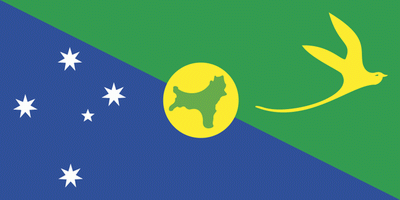
Quick Facts about Christmas Island
|
|
Become a supporter of this website for just $5 a month
|