DESCRIPTION
Marble Bar has the reputation as the hottest town in Australia. In 1923-4 the temperature remained above 100 degrees Fahrenheit for
162 days. The highest temperature recorded in the area is 49.4 Celsius. (121 F)
Marble Bar is the administrative centre for the shire of East Pilbara, which has an area greater than that of Britain & Ireland combined.
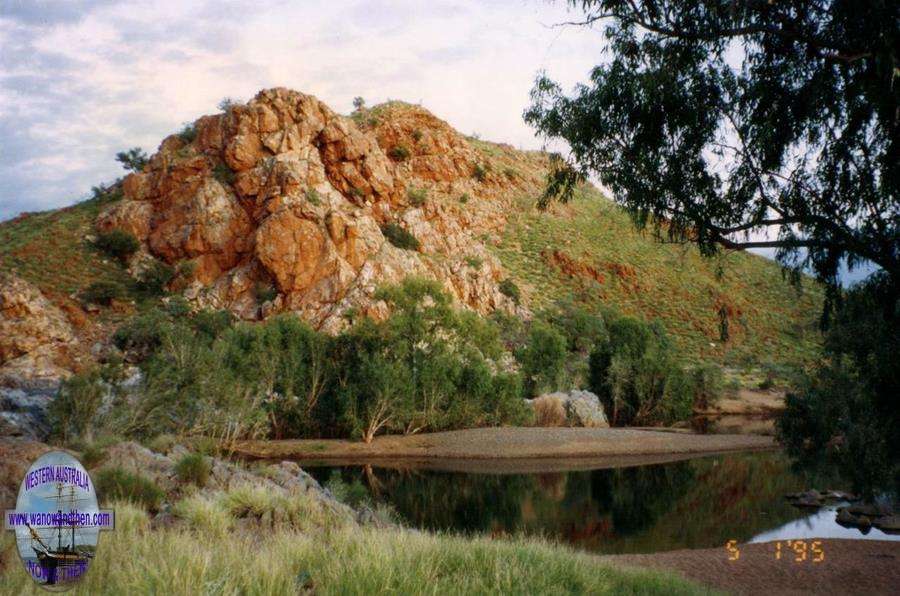
Marble Bar Pool and Chinaman's Pool are very close to town, and offer excellent photography, especially just after sunrise when the
rocks on he hills gleam like the gold which was mined nearby. We were lucky enough to arrive just before daylight and were treated to a
real 'vision splendid' as the sun rose and revealed one of the most beautiful places we have ever seen.
If you are heading south and have a 4x4, take the road past the Comet mine and on past Hillside Station. The countryside along this route
is perhaps the best you will see in the area (outside Karijini National Park).
Perhaps the most significant buildings in town are the Government offices. They are constructed of locally quarried stone and have a very
solid permanent appearance.
The town and its heat are described in Victor Courtney's poem 'The Man from Marble Bar.'
Satan sat by the fires of Hell
As from endless time he's sat,
And he sniffed great draughts of the brimstone's smell
That came as the tongue-flames spat;
Then all at once the devil looked stern
For there in the depths of Hell
Was a fellow whom never a flame could burn
Or goad to an anguished yell;
So Satan stalked to the lonely scene
And growled with a stormy brow,
'Now, stranger, tell me what does this mean?
You should be well scorched by now.'
But the chappie replied with a laugh quite new;
'This place is too cold by far
Just chuck on an extra log or two
I'VE COME IN FROM MARBLE BAR!
HISTORY
The town was named after a bar of jasper at the nearby Marble Bar Pool (which was originally mistaken for marble by an explorer called Nathaniel Cooke.)
The jasper is the only known bar of its type in Australia. Normally the jasper doesn't look all that exciting but pouring some water over it reveals its amazing colours.
Cooke was probably one of the first people to realise that the Pilbara was likely to yield gold and he spent a number of years mounting
expeditions in the hope of striking it rich. From his base at Mallina station he would head out into the wilderness but as is sometimes the case, Cooke was
unlucky. Unable to locate a good find for himself, he was generous with information about where he believed gold could be found and others profited greatly
from his advice. To top it all off when he sold Mallina to the Withnells, they found gold on the station - it had been right under his feet all the time.
Other stories about Nataniel suggest that he was also unwise about whom he shared information with. One who went on to profit from information supplied
by Cooke was a man called Beaton who reputedly got rich after staking a claim on land Cooke had found and eventually Beaton's Hill was named after the claim jumper.
The area began to develop in 1891 (some sources quote 1888) after gold and then tin was discovered. A town site was gazetted in 1893.
Francis, Jenkins and Edmondstone were the first to find payable gold in the area in April 1891. A month later there were 40 people in the area all looking for the
elusive gold.
By July 1893 the town site had been surveyed and gazetted. By the turn of the century it was decided that a railway to Port Hedland was
needed and when the line was eventually completed the service was only once a fortnight. With typical bureaucratic 'efficiency' the train left Port Hedland the day
before the regular cargo ship arrived ensuring that news and goods going to Marble Bar were always a couple of weeks late.
When the rail service ended in 1951 an effigy of the local politician was attached to it with a note that read:
'Our M.L.A. who gave the railway away. Port Hedland: We've had him, throw him off the jetty.'
The main lures to the area were gold and tin. Gold was not that plentiful and never reached the dizzying heights that the Kalgoorlie and
Murchison goldfields did but there were some inspiring finds like the General Gordon, a nugget that weighted in at 371 ounces. Two brothers and a friend were
working together when the nugget was found and the unwritten rule was that whatever was found was to be shared equally. When one of the brothers found
the General Gordon the friendship ended but the matter was decided in the local Warden's court and the unwritten rule was upheld.
The Little Hero was another large nugget found in the area and weighed 334 ounces. An even bigger nugget named the Bobby Dazzler was found near the location
of the General Gordon. Bobby Dazzler weighed 487 ounces.
(One account lists the story of how the Bobby Dazzler was found but it lists the nugget as weighing only 88 oz.) The story goes that two Irishmen were working
McPhee's Gully in an underground drive when they came across a tree root in the shape of a cross. Being superstitious they took it as an ill omen and abandoned
the drive. Some time later McPhee (who had originally worked the gully) came back and started working the same drive. He had no such superstitions about the
tree root and 10 feet beyond it he found the Bobby Dazzler that he sold for 350 pounds.
The Comet Goldmine still operates just south of town, but these days produces souvenirs rather than gold ore.
During the Second World War a secret long range bomber base was built on Corunna Downs. B24 Liberators operated from this remote site bombing Japanese
targets to the north. The base was so secret that few people, even today, are aware that it had been there.
TALL TALES AND TRUE
Slow train or quick crop.
The Spinifex Express that ran from Marble Bar to Port Hedland was a slow service. When one passenger asked the driver why he was throwing tomato
seeds down by the side of the track, the reply was: 'The guard is picking tomatoes.' (The guard was on the last carriage.)
Moonlight dip.
There is a legend that if a woman with a warm heart swims in the river pool at Marble Bar during a moonlit night, her heart will turn cold but her body will become
as beautiful as that of Psyche.
There seems to be something about Marble Bar that inspires those who have been there to write about it. Not everything is complimentary but not all is negative
as the following couple of bush ballads show:
Marble Bar
I know the town that God forgot
It's Marble Bar
The coolest drinks are always hot
At Marble Bar
The place affects you with a thirst
You drink until you nearly burst
And life is a thing accurst
At Marble Bar
The sweat teems from you, in a flood
At marble Bar
Spit ere it lands, turns into mud
At Marble Bar
The flies are bad without a doubt
So thick they shut the sunlight out
You have to grope your way about
At Marble Bar
Strange insects mark you down as prey
At Marble Bar
You get no peace by night or day
At Marble Bar
They buzz and hum and crawl and creep
And if your sanity you'd keep
Under a net you've got to sleep
At Marble Bar
A blistered, blasted, burnt up hole
Is Marble Bar
The sky above - a barren scroll
O'er Marble Bar
Set in a barren broken range
Hades would make a pleasant change
From Marble Bar
Annon.
Published in The Westralian Worker.
A slightly different view was taken by the next bush balladeer who had obviously seen the preceding poem.
Marble Bar
You boast about your city, Perth
But Marble Bar
Is the only spot that's Heaven on Earth
Sweet Marble Bar
Where pleasantly the moments flow
And gentle breezes softly blow
And strenuous work is quite 'de-trop'
At Marble Bar
Our hardest work is only play
At Marble Bar
We yarn to pass the time away
At Marble Bar
Or else we laze beneath the shade
Like Omar with some dusky maid
Near Marble Bar
We rise - well not before the sun
At Marble Bar
And count the day as well begun
At Marble Bar
If we can score a beer or gin
In payment for the tales we spin
To strangers who have wandered in
To Marble Bar
And then we show the strangers round
At Marble Bar
And talk of minerals that abound
Near Marble Bar
We strive to interest them, and so
We show them where the nuggets grow
And reefs that hold the gold below
Near Marble Bar
Oh blessing on this sun kissed spot
Dear Marble Bar
For the wants of life are easily got
At Marble Bar
At parting cash in massive piles
From tourists whom the North beguiles
It beats all other towns by miles
Does marble Bar
Annon.
The following was apparently seen in the Ironclad Hotel.
I was born black
When I'm cold I'm black
When I'm scared I'm black
When I'm sunburned I'm black
When I'm sick I'm black
and when I die I'm still black
You were born white
When you're cold you're blue
When you're scared you're yellow
When you're sunburned you're red
When you're sick you're green
and when you die you go grey
and you've got the hide to call ME coloured.
VIDEO
PROBLEM PLAYING THESE ON FIREFOX?
Turn off Enhanced Tracking Protection
Click the shield icon left of the URL near the top left
Slide Advanced Tracking Protection to OFF
(C) johnnybaustralia YouTube channel.
OTHER INFORMATION
ATTRACTIONS
Marble Bar Pool, Chinaman's Pool, Coongan River, Flying Fox lookout, Coppin's Gap, Kitty's Gap, Ironclad Hotel, Pioncianna House, Pioneer memorial wall, State battery.
BUILDINGS OF NOTE
Government offices 1895.
ELECTORAL ZONES
State : Pilbara
Federal : Durack
OTHER INFO.
Postcode : 6721
Local Government : Shire of East Pilbara
PHOTOS
Click on a thumbnail to see full sized picture.
Please note that using the https url will cause the photos not to show. To show photos use the standard http url.