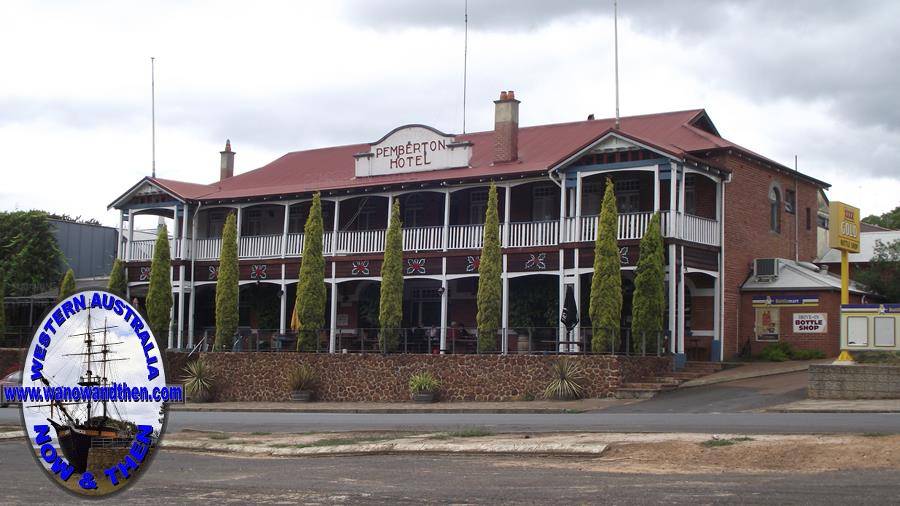
DESCRIPTION
Deep in the heart of karri country, Pemberton is one of the coldest towns in the state. The surrounding forest is breath taking. An under storey of ferns and bracken is usually damp and earthy smelling.
Smaller trees and bushes clump together beneath majestic karri trees making the forest almost impenetrable.
The town's most popular tourist attraction is the huge Gloucester Tree with its fire lookout teetering 64 m above the ground and its hair-raising 153 rung ladder to the top. It is claimed that the view from
the top is magnificent but, if there is a wind blowing, the experience of swaying from side to side is apparently less than comforting.
There is a trout farm where visitors can fish but dropping a line into a muddy pond full of hungry fish is hardly my idea of fishing.
The Pemberton to Northcliffe Railway, which was completed in the early 1930s, runs a small tram through the forest. This is scenic journey with the railway crossing rivers and passing areas which, in
spring, are ablaze with wildflowers. When it was built the railway from Pemberton to Northcliffe was the most expensive in Western Australia costing about '20 000 a mile as it cut its way around hills and across
bridges. The journey, which runs daily, takes 4 hours and tickets and timetables are available from the Pemberton'Northcliffe Visitor Centre.
Trout fishing in the local rivers is very popular and over 1 million hatchlings are released each year to keep stock up. (An inland fishing license is required in south west W.A.)
Marron (freshwater crayfish) can also be caught in the lakes and streams but catching them is strictly controlled and you also need a license from the Fisheries department.
Access to the wild south coast for conventional vehicles in this area is limited to a sealed road from Northcliffe to Windy Harbour. 4 wheel drive vehicles have a better choice of routes and can reach
some of the more inaccessible and unspoiled areas.
There are some excellent campsites in the area including Big Brook and Warren River.
Karri forest
Eucalyptus diversicolor (karri) is so named because the bark peels off and slowly changes colour giving a variety of hues from grey, to salmon and brown.
The karri trees are the tallest in Australia (reaching 90 metres) and one of the tallest trees in the world.
Karri trees will usually flower and set seed after a bush fire to take advantage of the extra nutrients released into the soil from ash.
They occur in a wide band starting near Nannup and extending south west to Walpole.
HISTORY
The area was first settled by Edward Brockman (who later married Capel Bussell) after an expedition to the area in 1861 with Gerald de Courcy Lefroy and Pemberton Walcott. Sadly the Aboriginal
inhabitants of the area were decimated by influenza and measles after the arrival of Europeans.
The survivors moved away to the Busselton area in 1912, and today not one of the tribe's descendants remain.
The area was first known as Big Brook but when the town site was declared in 1912 the name Walcott was first proposed and rejected (due to a conflict with Port Walcott near Wickham
in the Pilbara) before Pemberton was accepted. The town is named after Pemberton Walcott who settled in the area in 1862, but only stayed for 2 years.
Two Islands near Karratha are named after the same man.
A state saw mill was established in 1913 to supply 500,000 sleepers for the trans-Australia railway. By 1939 it was the largest milling complex in Australia and today remains one of the largest in W.A.
The townsite was surveyed and gazetted in October 1925
TALL TALES AND TRUE
No information for this section yet. If you know of something we can add here please contact us and let us know.
VIDEO
PROBLEM PLAYING THESE ON FIREFOX?
Turn off Enhanced Tracking Protection
Click the shield icon left of the URL near the top left
Slide Advanced Tracking Protection to OFF
OTHER INFORMATION
ATTRACTIONS
Warren and Beedelup National Parks, Pemberton Pool, Gloucester Tree, Pioneer Museum, 100 Year Old Forest,
Brockman saw pit, Cascades, Tramway, Founder's Forest, Big Brook Arboretum Campsite
Big Brook, Saw Mill, Yeagarup Lake, Lavender and Berry farm.
BUILDINGS OF NOTE
Picture theatre and hall 1930s, Warren house 1862, Wandagarrup 1920, Church of St. Mark 1883.
ELECTORAL ZONES
State : Blackwood-Stirling
Federal : O'Connor
OTHER INFO.
Postcode : 6260
Local Government : Shire of Manjimup
PHOTOS
Click on a thumbnail to see full sized picture.
Please note that using the https url will cause the photos not to show. To show photos use the standard http url.