DESCRIPTION
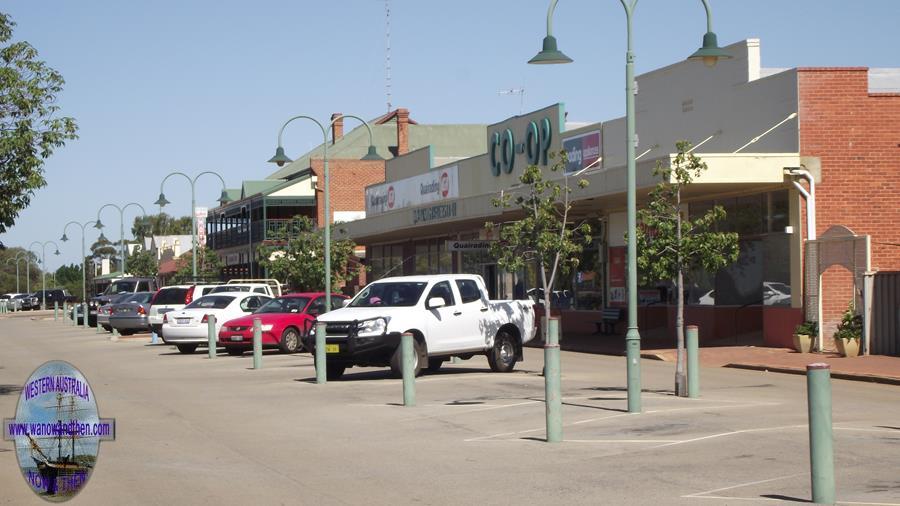
Quairading is a farming service centre located about 2 hours drive from Perth.
The town is attractive and offers good amenities for travellers who want to explore the area.
There are toilet facilities including showers, dump point, water pickup and a large day use parking area as you enter town from the west.
A heritage drive trail will lead you to historic sites and there is a nice bush campsite at Toapin Weir where you can swim. The site includes a BBQ with electric light, Flushing toilet, water, seats, tables and shelters.
The area experiences occasional earthquakes and a 3.2 magnitude quake struck in April 2009. Thankfully no damage occurred.
HISTORY
Prior to European settlement the area around Dangin Springs was used by the Aborigines as a meeting place. It is known that hundreds of
people at a time would meet there to trade and perform ceremonies.
The name Dangin comes from the Aboriginal word for needle bush that was prevalent in the area.
The first lease in the area was taken up by Stephen Parker in 1836 and his son Edward Read Parker moved on to the lease in 1859.
The lease was subsequently developed by Edward’s son Jonah who developed a private townsite called Dangin that was gazetted in 1902.
Jonah was a strict teetotaller and this may have been the impetus for the development of Quairading in 1905.
In 1892 a eucalyptus distillery was started up and used leaves from local salmon gums. It initially did quite well winning awards at
various interstate and international shows for its quality. Eventually costs rose too high and competition from the eastern states
forced the facility to close. The oil was distilled three times and was widely used as an antiseptic. When the plant closed F.H.
Fauldings of Perth purchased the manufacturing rights.
Jim Caldow opened a store and soon other buildings began to appear nearby. By 1907 the new townsite of Quairading had been gazetted.
The railway arrived a year later and the town saw even greater development. Teetoal Dangin then started a swift decline.
The name Quairading may have been derived from an Aboriginal word ‘quara’ meaning bush kangaroo or it may have come from the word
‘quairit’ meaning young girl. Kwerading was first suggested but the ‘Q’ spelling was already in local use and was adopted when the
townsite was gazetted in 1907.
After the railway arrived the town developed quickly and by 1910 there were a number of businesses in town including two banks, a
hotel, blacksmith, general store, baker and carpenter.
TALL TALES AND TRUE
No information for this section yet. If you know of something we can add here please contact us and let us know.
VIDEO
PROBLEM PLAYING THESE ON FIREFOX?
Turn off Enhanced Tracking Protection
Click the shield icon left of the URL near the top left
Slide Advanced Tracking Protection to OFF
OTHER INFORMATION
ATTRACTIONS
Home of natural wood sculpture, Cubbine, Toapin Weir, Mt. Stirling, The Grain Family, Shenton Gallery, Heritage trail, Toapin Weir, Vintage Club, Rabbit Proof Fence No. 2, Bina Wildlife park, Pink Lake, Nature Reserve.
BUILDINGS OF NOTE
Hotel, Post Office, Town Hall.
ELECTORAL ZONES
State : Central Wheatbelt
Federal : O'Connor
OTHER INFO.
Postcode : 6315
Local Government : Shire of Quairading
PHOTOS
Click on a thumbnail to see full sized picture.
Please note that using the https url will cause the photos not to show. To show photos use the standard http url.