|
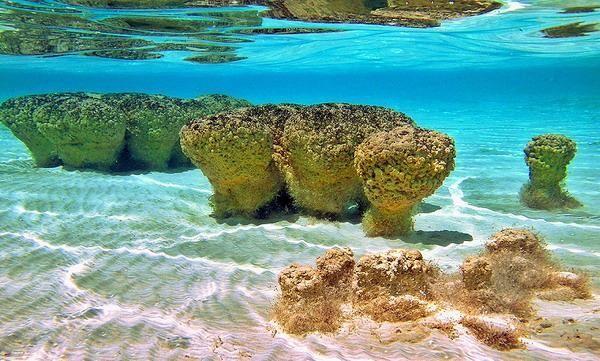
These look for all the world like some type of rock but they contain some of the earliest forms of life that exist on the planet today. 'it's not the sight of stromatolites that makes them exciting.
It's the idea of them' - Bill Bryson
The rock like structure is produced by the excretions of a type of blue-green algae that is thought to have originated some 3,500 million years ago and for 2,850 million years they were the only
evidence of life on the planet. There are some 50 species of cyanobacteria found at the Hamelin Pool site alone. They are the simplest form of single cell life known to exist.
Population densities have been estimated at 3,000,000,000 per square metre and the structures they create can be 10,000,000 times larger than the individual organisms.
The structures formed by the micro-organisms grow very slowly. Estimates put the growth rate at around just half a millimetre a year. Hamelin Pool is one of only two places in the world where
these structures occur.
The name 'stromatolite' actually means 'layered rock'.
The cyanobacteria secrete a sticky residue that attracts and holds sand and sediment and over time this solidifies to create the structures we call stromatolites. It is only the outer layer of the
structure that contains the living organism.
The structures built by these microscopic creatures can be as high as 1.5 metres and they can live in the sea at a depth of up to 4 metres. (As they depend on sunlight 4 metres is the
maximum depth they can grow at.)
A similar organism called a thrombolite is found in Lake Clifton south of Mandurah.
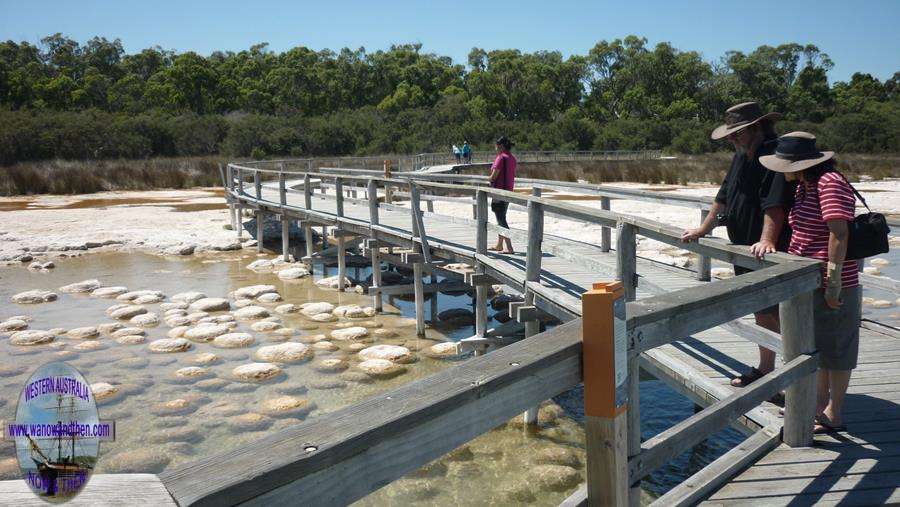
Thrombolites at Lake Clifton.
It is thought that organisms similar to these, originally helped lay down the immense iron ore deposits in the state's north west. The organisms seem to require shallow water and the influx of fresh
groundwater that is high in calcium carbonate. During photosynthesis the algae lays down this calcium carbonate and keeps on building up the structure it lives on.
As they grow very slowly they are unable to exist in environments that have a large diversity of life as they are easily out-competed. Hamelin Pool is cut off from the main ocean by a bank of
silt called the Faure Sill. This restricts the entry of fresh sea water and maintains very high salinity in the pool area. This in turn restricts the types of sea life that can exist in the pool. It is likely
that with rising sea levels that very soon the Sill will be breached and other types of life like corals may displace the stromatolites.
It is also believed that these life forms were responsible for building up the oxygen content of the atmosphere to about 20% and this allowed the evolution of oxygen breathing species including
human beings, so although stromatolites may look rather unimpressive we actually may not have existed if they had not been there in the beginning.
There are three known locations in the world where stromatolites are found and the other two are in the Bahamas. Thrombolites seem to be more widespread and can be found in several lakes
around the world. In W.A. they exist at Lake Thetis 12 Km south east of Cervantes, Pink Lake near Esperance,
Lakes Preston and Lake Clifton near Mandurah and Lake Richmond in Rockingham.
It has to be remembered that stromatolites are not ancient as individuals. They are in fact modern life forms with an ancestry dating back 1,900 million years. The stromatolites in Hamelin Pool
are thought to have been inhabiting that area for about 2,000 years.
Other Old Life Forms
While stromatolites are an ancient life form, they are not individually that old. If we are looking for something that is alive today that has been alive for a very long time as an individual, then it is
hard to find anything in W.A. that is older than the Meelup Mallee tree. Scientists estimate that this one individual is over 6,000 years old.
There is currently an attempt under way to clone the tree using tissue culture, as there are no others left for this one remaining to cross pollinate and so it never sets any seed.
It currently sits at the top of our rarest and most endangered species list.
As a comparison, the oldest living individual organism on the plant is a species of Huon pine living in Tasmania that is believed to be at least 15,000, and possibly up to 25,000 years old.
Ancient Land
While we are on the subject of things ancient, it is difficult not to mention the land itself. Although not a living thing in itself, it is that land that supports a vast array of life and when animals become
fossilised, helps us 'see' into the past.
Western Australia contains some of the oldest undisturbed land on Earth. The eastern states were no more than mud at the bottom of an ancient sea when W.A. was already very old.
In a place called Jack Hills, zircons have been discovered that were created around 4.4 billion years ago. Although there was no life on Earth that long ago, the zircon crystals contain elements
that allow scientists to find out what conditions were like at the time. To date, these zircons are the oldest terrestrial objects ever found on Earth.
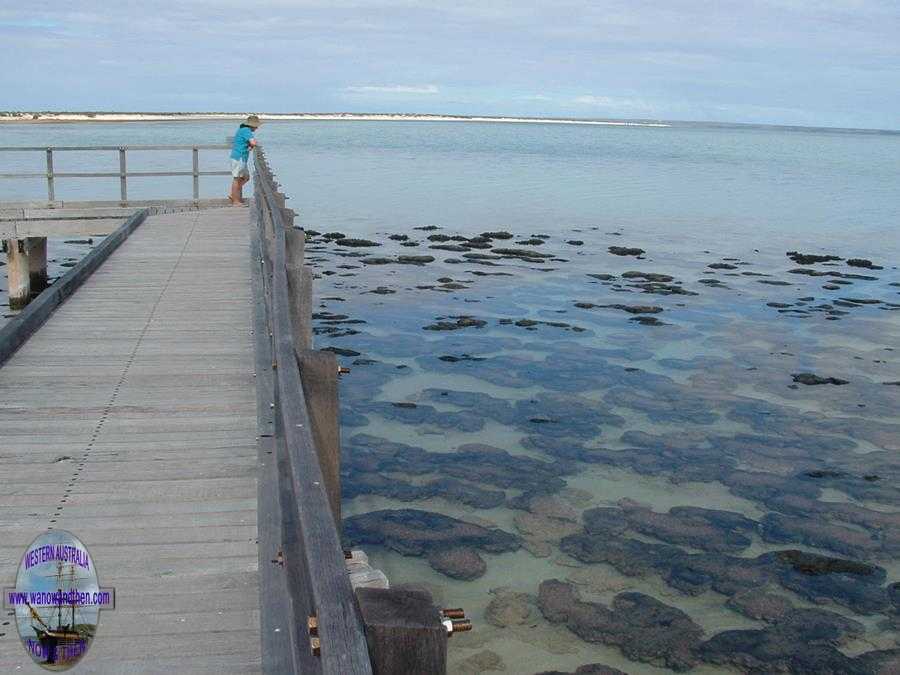
Stromatolites at Hamelin Pool.
|