DESCRIPTION
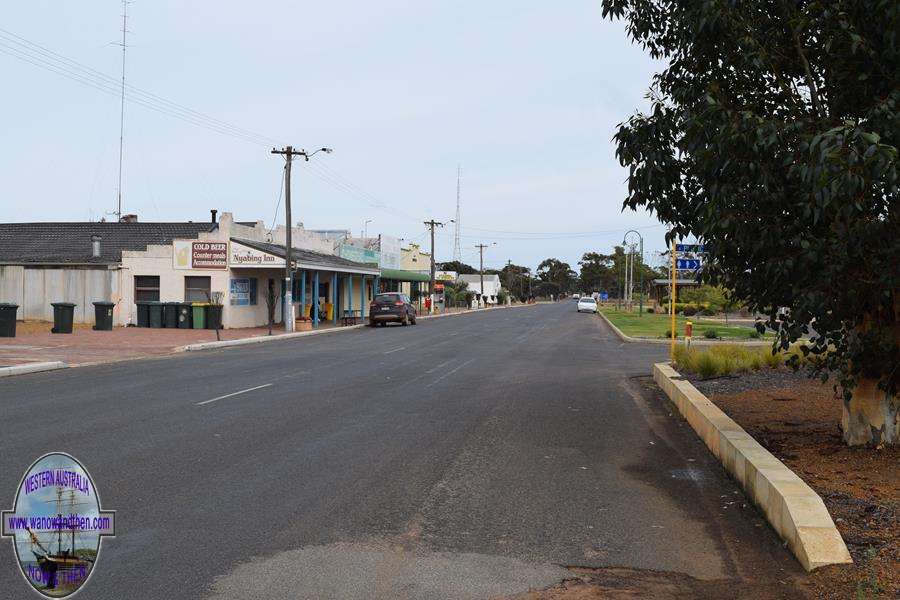
Nyabing is between the large regional centre of Katanning and the small town of Pingrup.
It is a small service centre for the Shire of Kent. There is a good general store, local inn and a useful rest area for travellers.
HISTORY
The area surrounding the town was originally established as the Kent Road Board in 1923. In 1955 the name was changed to the Nyabing-Pingrup
Road Board but in 1973 it went back to the name of Kent again, but this time as a shire.
Originally known as Nampup Soak, the townsite was surveyed by F.M. Bee and the town was gazetted in 1912. Nampup was considered to be too
similar to Nannup so was changed to Nyabing later the same year. Originally the names Narrara and Wingar were suggested but W. J. Rae, the
District Surveyor, suggested the name 'Naiabing' as it was thought to be the original Aboriginal name for the soak. The name was accepted but in
the altered form of Nyabing as this was considered to be a simpler method of spelling the name.
The name was first believed to have come from Danish town called Nykobing but another source may be the Aboriginal word for the everlasting
flower 'ne-yameng'. Nyabing is 60 Km east of Katanning, 50km south of Dumbleyung and 315km south
of Perth.
Early settlers in the area were: Henry Hayward, John O'Flaherty, Hassall, Charsley, Johnston, Langley, Manuel, Quartermain, Shields, Altham,
Currie, Clegg, Deacon, Ford, Jolly, Sanderson, Watson, Whowell, Wicks and Hobley
The local economy is based on farming with wheat, sheep, barley and canola being the main products.
Some statistics recorded by the ABS for farming produce from the shire are:
Wool Clip 1,961,000kg
Wheat Produced 141,000 tonnes
Barley Produced 55,000 tonnes
Number of Sheep 414,000
Number of Pigs 11,000
TALL TALES AND TRUE
No information for this section yet. If you know of something we can add here please contact us and let us know.
VIDEO
PROBLEM PLAYING THESE ON FIREFOX?
Turn off Enhanced Tracking Protection
Click the shield icon left of the URL near the top left
Slide Advanced Tracking Protection to OFF
The video is about Nyabing and other towns.
OTHER INFORMATION
ATTRACTIONS
Gnamma Holes, Grader Monument, Holland Tank, Holland's Track, Lake Bryde, Nampup Soak, Pink Lakes,
Nyabing Creek nature reserve, Kwobrup Dam, Cairlocup Dam, Chook run, Chinocup nature reserve, Memorial park.
BUILDINGS OF NOTE
Historical School Building.
FAMOUS SONS AND DAUGHTERS
ELECTORAL ZONES
State : Wagin
Federal : O'Connor
OTHER INFO.
Postcode : 6341
Local Government : Shire of Kent
PHOTOS
Click on a thumbnail to see full sized picture.
Please note that using the https url will cause the photos not to show. To show photos use the standard http url.