DESCRIPTION
NOTICE SEPTEMBER 2023 : Wittenoom is no more. The final phase of demolition began in April 2023 and there is now nothing left
of what was once, Western Australia's largest north west town.
Article on Wittenoom : Blue Murder At Wittenoom - by Ludwig Heinrich.
One of the most beautiful and tragic areas in the state. The gorges are among the most striking and haunting you will find anywhere.
The town serviced asbestos mines which led to the deaths of many of the town's inhabitants. The dust created by the mining operations led to the development
of specific and deadly cancers which have claimed the lives of many people who worked in the town. The company responsible for the mine knew the effects
of blue asbestos dust, but did little to protect the workers or their families. Instead of paying compensation to the sufferers, long court battles ensured that
most died before any settlement could be reached.
The dangers of asbestos dust were known at least as early as 1900. The first diagnosed case of mesothelioma in Australia was in 1960*. The worker had been
employed by CSR at Wittenoom. Dr. Jim McNaulty, who made the diagnosis, warned CSR of the danger but they ignored him.
In fact it was not just CSR that ignored the increasing number of dire warnings about an impending industrial disaster but also the West Australian
government that actively hid the details and sided with the company. It was not until 1985 that paperwork finally emerged from the government bureaucracy
showing that it had known for decades about the danger of asbestos mining but had done nothing to protect the workers and their families.
Even the unions and the press were complicit in this conspiracy of silence and all of them were responsible for the tragedy that unfolded.
The Charles Court Liberal government had resisted all attempts to acess the paperwork associated with Wittenoom, with the Minister for mines,
Andrew Mensaros, even falsely claiming that all documents relating to Wittenoom had been destroyed.
Both the Mines department and the Health department had allowed the mine at Wittenoom to continue operating in flagrant breach
of the health and safety laws that the departments were meant to enforce.
To be fair to the Health department, a number of doctors had raised the alarm and reported that Wittenoom would result in
"the richest and most lethal crop of cases of asbestosis in the world's literature." but their warnings were ignored.
These warnings were made as early as 1948, when there was still a chance of saving the 4000 plus lives that would eventually be lost.
Even when the mine finally closed in 1966, the unions could only complain about asbestos being imported from South Africa and the loss of miner's jobs.
Nobody who could have acted to help the miners did anything and the few doctors and mine inspectors who did raise the issue were dismissed
as trouble makers. CSR simply ignored any attempts to get the mine properly cleaned up and everything was covered up for decades.
What of the workers themselves? Surely they knew how bad things were and tried to make changes? Yes they did and the actions of Allan Hume serves as
an example of how any worker who dared raise the issue was treated by CSR. Allan had suggested that the ore was wetted down before crushing. This would have
greatly reduced dust levels but for his trouble, Allan was sacked on the spot.
If you visit the area stay well away from the tailing heaps, which are clearly visible near the mining sites.
At the time of writing the town is still maintained by a few die-hards - no pun intended - but most of the old buildings have been removed and it will only be
a matter of time before it is completely abandoned.
Last time we were in the area Yampire Gorge had been washed out and was impassable. We have since been told that it is now possible to get through again
but only with a high clearance 4x4 and care needs to be taken.
One unusual piece of information: We have read that a young Rolf Harris worked in Wittenoom in 1948 before embarking on a more successful career in entertainment.
In a somewhat odd coincidence, Rolf's father died of asbestosis.
* - The first case of asbestosis associated with Wittenoom was Ian Dignam who contracted it as early as 1946 but was not properly diagnosed until
much later.
Personal observations:
Walking through the old abandoned houses, looking as the bits and pieces left behind, seeing little stone pathways with rock edges put in by the people who are
now long gone, left me with a great sense of melancholy. Fragments of people's lives, echoes of a tragedy that never should have happened. I find it a very strange
place because of the beauty and because of the deaths of so many people who worked and lived there. The fact that the government is 'hell bent' on erasing the town
from the map and pretending that it never existed, fills me with disgust. The town should have been left as it was, as a memorial to those whose lives were needlessly
taken by greedy uncaring business.
The power station in Wittenoom was closed down and the town has been de-gazetted by the W.A. government. This was done so that access to the town could
gradually be choked off. There will probably come a time when the town and nearby gorge are inaccessible. The government is so scared of litigation over asbestos
in the area that access to this wonderful area will be lost to the public. What a shame then that when the dangers were first discovered, the government of the day
sat on its hands and did nothing.
Almost every building we saw in 1995 has now been demolished and very little of the old town remains.
I was so moved by this place, the beauty and the tragedy that I wrote about it myself as follows:
Wittenoom
A melancholy little town
half dead and half alive
Polluted by a deadly waste
it struggles to survive
A mining town where workers came
from here and overseas
They never knew their lives were touched
by fatal lung disease
They toiled beneath a clear blue sky
through rains and through the heat
A town in deadly paradise
asbestos on their feet
Much later when the men grew sick
and then began to die
The company denied their claims
but knew it was a lie
In court they dragged the cases out
until the bitter end
and wives now widows went without
their lovers and their friends
The deadly dust lies everywhere
but some still struggle on
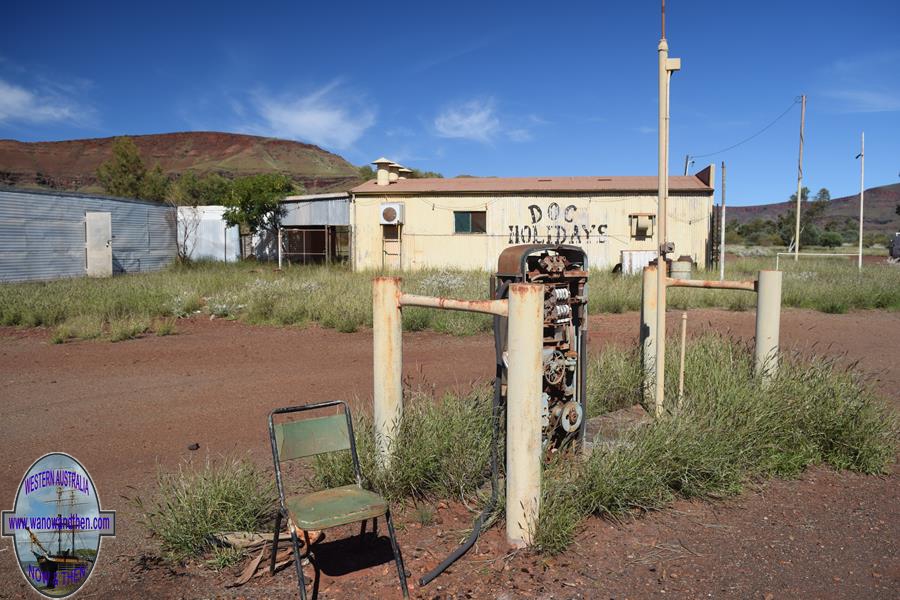
The pub is standing empty now
the petrol station gone
The miners ghosts are wandering
the silent lonely town
Their spirits haunt the empty streets
that they had once walked down
(C) 1995
Check out more ballads at http://www.wanowandthen.com/Ballads/index.html
HISTORY
Wittenoom was named after Sir Edward Horne Wittenoom ** (1854 -1936)
a politician (Minister for Mines). Strange that politicians are now so determined to destroy the town.
** Another source quotes Frank Wittenoom as the source of the name. (Our research indicates that E.H. and F. Wittenoom were in fact brothers.) Frank was said
to be a partner of Lang Hancock
who initially developed the site before selling out to CSR in 1943. (We haven't managed to confirm this and as Frank Wittenoom died in 1939 we think it may be unlikely.)
Frank Wittenoom (1855-1939) originally owned Mulga Downs and sold it to George Hancock. This may be the source of the Wittenoom - Hancock partnership.
George Hancock was Lang Hancock's father. To muddy the water even further Frank's correct name was Frederick Francis Burdett Wittenoom.
The presence of asbestos in the Hamersley Range had been known since 1917 and was reported as being at Yampire Gorge in 1924. The first asbestos claim was made
around 1930 with the prospector being led to the site by an Aborigine named Weano.
The town was gazetted in 1950 and in 1951 it changed to Wittenoom Gorge. In 1974 it went back to being just Wittenoom again.
The asbestos mine was in operation from 1943 to 1966, and despite the health risks associated with asbestos dust, it only closed for economic reasons. Over
150,000 tonnes of asbestos were shipped out from Cossack and Point Samson. Of the 20,000 people who lived
and worked in Wittenoom over 4,000 have already died from asbestos related diseases. Projections once suggested that 25% of those who worked there will die directly
as a result of exposure to asbestos dust. Today that figure is looking somewhat under-stated.
It may seem very strange to us now - knowing what we do about the dangers of asbestos - but asbestos tailings were mixed with the red soil in gardens, schools
and roads to break up the monotony of the red earth. Many children played in the tailings and a great many were to die as a result of the exposure.
The asbestos disaster that occurred at Wittenoom rates alongside other major industrial catastrophes such as Chernobyl and Bhopal in the number of people that
will ultimately die.
Asbestos was so useful in various products that it spread to eco-systems world wide. It was used as insulation, in car brake pads, in fabric, ironing boards, ropes, gloves
conveyor belts, gas masks and even in something as incouous as Play Dough.
So what does this mean for people who never lived at Wittenoom or handled asbestos products? Well the long term outlook is hardly encouraging. Asbestos fibres have
become part of the world around us and autopsies in places like Melbourne, routinely show 50,000 asbestos fibres in every gram of lung tissue in people who have
never worked with asbestos. It has even shown up in the lungs of newborn babies. Mesothelioma is a diagnosis that now hangs over many people, not just those who
worked in the asbestos mines, carted the sacks to the ports or who loaded it on to ships.
The abject failure of government, the criminal neglect of CSR and the general apathy associated with asbestos mining at the time has resulted
in a time bomb that never stops ticking.
So in the end did CSR take responsibility for its actions and compensate the families of those who had died? Oh no! not in the least. They hired armies
of lawyers including Julie Bishop (who later went on to become a federal Liberal government minister) to defend the company. Cornelius Mass was the first victim to sue CSR beginning in 1977
and the ensuing legal battles involving other former miners and their families would stretch out over 11 years and cost
over $20 million in legal expenses alone.
Cornelius did not live to see the outcome of these battles as he died just a month after instigating the legal fight for compensation. The pittance already being paid
by the state insurer SGIC, was then cut off and his widow was left to fend for herself.
CSR adopted a strategy of delay, as they knew that the legal system was slow and cumbersome but the mesothelioma was a quick and merciless killer.
Case after case either collapsed when the complinant died or was dismissed by judges who showed a remarkable lack of compassion and understanding of the issues.
It was not until a case brought by Klaus Rabenault in the Victorian Supreme Court that the asbestos victims finally had a win. $426,000 in compensation and $250,000
in punitive damages was awarded when the jury found that the company was recklessly indifferent to the safety of its workers. Unfortunately the
verdict was against the subsidiary company (Midalco - formerly Australian Blue Asbestos) not against the parent company CSR.
At the same time another case (Heyes and Barrow) was being heard on the other side of the country in Perth.
CSR had a four stage defence plan. First to claim that they were not responsible because the wholly owned subsidiary company (Midalco) ran the mine at
Wittenoom. Next they tried to claim that they had never seen the hundreds of documents relating to the impending disaster.
Then they claimed that breathing protection had been offered to the workers but they had not made use of it. Lastly and probably most disgraceful of all,
they claimed that asbestos was not the cause of the men's deaths.
One by one these fatuous arguments were picked apart. Peter Hayes had died as the trial progressed and Tim Barrow was to die just two months after
the verdict was handed down.
The result was just $216,000 for Barrow and $155,000 for Heys - who was already dead. In Melbourne CSR launched an appeal but it was thrown out.
Over a decade and $20 million dollars had been spent defending the indefensible.
The SGIC, that had been standing shoulder to shoulder with the morally bankrupt CSR, now abandoned its former ally. Not just abandoned but turned on them
with a vengeance.
Such is the way of organistions that have no moral compass and are only interested in their own survival.
Instead of just rolling over, CSR decided to continue to make things as difficult as possible. They knew that an avalanche of claims were now
headed their way but they continued to delay, to try and reduce compensation payouts and to deny responsibility.
The tentacles of this disaster spread around the world as men who came from other countries to work in Wittenoom returned home. It was not until
years later that Wittenoom's grim reaper reached out to tap them on the shoulder.
The lies, the decipt, the delays and the immorality of government and companies are some of the most disgraceful acts that have ever
been perpretrated on innocent workers. They are a dire warning of what happens when corporatism takes hold and lives are measured in dollars.
Estimates put the compensation bill in the western world at something around $300 billion in the three decades after 2008. Although asbestos products
were FINALLY banned in Australia in 1990 they are still produced in Russia, China and possibly most surprisingly, Canada.
These products are still being sold to developing countries so the toxic curse of asbestos is continued for future generations.
TALL TALES AND TRUE
No information for this section yet. If you know of something we can add here please contact us and let us know.
VIDEO
PROBLEM PLAYING THESE ON FIREFOX?
Turn off Enhanced Tracking Protection
Click the shield icon left of the URL near the top left
Slide Advanced Tracking Protection to OFF
OTHER INFORMATION
ATTRACTIONS
Wittenoom Gorge, Yampire Gorge.
BUILDINGS OF NOTE
Anything that is still left of the town.
ELECTORAL ZONES
State : North West Central
Federal : Durack
OTHER INFO.
Postcode : 6751
Local Government : Shire of Ashburton
PHOTOS
Click on a thumbnail to see full sized picture.
Please note that using the https url will cause the photos not to show. To show photos use the standard http url.
Our thanks to the following people for contributing photos to this page:
Caroline Brocx,
Gladysclancy.