|
|
|||

|

|
|

|
|
|
|||
EARLY EXPLORERSand unwilling settlers
|
|
|
|
|
|
WE NEED YOUR SUPPORT. |
|


|
|
|
'This land is a barren arid plain, where no fruit trees grow, nor is there any growth fit for the use of man' The natives are barbaric and coal-black. They are utterly unacquainted with gold, silver, tin, iron, lead and copper, nor do they know anything'' Jan Carstensz, Commander of the Dutch ship Arnhem.
Such was often the view of early European explorers as they skirted the coast of what was then just called the South Land. I wonder what they would say if they returned today.
The explorer Ernest Giles wrote of the early navigators:
'It is to be remembered that they came neither for pleasure nor for rest, but to discover the gulfs, bays, peninsulas, mountains, rivers and harbours, as well as to make acquaintance with the native races, the soils, and animal and vegetable products of the great new land, so as to diffuse the knowledge so gained for the benefit of others who might come after them. In cockle-shells of little ships what dangers did they not encounter from shipwreck on the sunken edges of coral ledges of the new and shallow seas, how many were those who were never heard of again; how many a little exploring bark with its adventurous crew have been sunk in Australia's seas, while those poor wretches who might, in times gone by, have landed upon the inhospitable shore would certainly have been killed by the wild and savage hordes of hostile aborigines, from whom there could be no escape!'
One of the problems in trying to work out which was the first nation to explore the coastline of Australia is that information on newly discovered lands was generally kept secret for fear of other nations involving themselves in the new lands. This was clearly evidenced by the fact that Torres discovered the straits named after him but for a long time afterward no other nation was aware that Australia and New Guinea were in fact separate.
Maps made in 1420 by the Chinese Admiral Cheng Ho (Zheng He) are reported to show part of the west coast of Australia but records that far back are unable to confirm any landings. The Chinese are known to have travelled widely through out the Indian Ocean and had invented the stern rudder and compass that would have allowed them to travel great distances across the sea. It is thought by some historians that the Chinese may have discovered America well before the Europeans but it seems unlikely that proof will ever be found as all the logs of the Star Fleet were deliberately destroyed when China embarked on a course of isolationism. There is a 1763 map that is said to be a copy of the Cheng Ho map and if it turns out to be genuine it will leave no doubt that the Chinese discovered America 70 years before Columbus.
There is evidence that the Portuguese visited and mapped the Australian coast as early as 1522. Two Portuguese canons were found on Cannonade Island and were dated no later than 1525. A map, known as the Dauphin map (made in 1536) is thought to be a composite of maps made by Mendoca in 1522 and Sequeria in 1525. It shows part of the west coast north from Shark Bay and then (much more accurately) the Kimberley and Northern Territory coast to the Gulf of Carpentaria. Sections are also very similar to the Queensland coast. The land mass was called Jave la Grande by the Portuguese.
Early navigation was fraught with danger. It was difficult for early navigators to fix their latitude and longitude and their calculations were often out by as much as 300 miles. The Dutch pioneered a route from the Cape of Good Hope (South Africa) to Batavia (Java) using the winds of the 'roaring forties'. This took ships well south and then east on what turned out to be a collision course with Australia for those ships that did not turn north early enough. If they chanced upon the Australian coast at night then they were very likely to run into a reef or to be smashed up on cliffs.
Dutch vessels, at the time, could not sail close to the wind and due to inefficient rudder systems they could not turn away quickly if danger was sighted ahead. Even with these problems they were great seafarers making an estimated 10,000 voyages to Indonesia.
In 1503-4 the French explorer Binot Paulmier De Gonneville was blown off course and landed on an unknown land. People have speculated that he landed in Australia but this has never been proven. He reported on natives living in huts which does not fit the lifestyle of many of the Australian Aborigines who generally had no fixed structures to live in. It should be noted, however, that Lt. George Grey later noted in his manuscripts about his experiences along the Kimberley coast that he did in fact find Aboriginal settlements where huts were in use and a 2007 exhibition put on by the W.A. Museum, De Gonneville was credited with stopping in the Kimberley region for a period of about six months. (Our thanks to Catherine Vann for bringing the latter part of this information to our attention.)
In 1602 the Portuguese may have made the first European landing on Australian soil.
In 1605-6 the Dutch ship Duyfken (Dove or possibly Little Dove) - spelled Duyfhen in one source - with Williem Jansz (or Janszoon) made the first confirmed sighting of Australia (Cape York) as they passed through the southern end of Torres Strait. Janszoon mistakenly believed Cape York was part of New Guinea. He named the place he turned back Keer-Weer, or Turn Again.
The crew is said to have come ashore near the mouth of the Pennyfather River. Janszoon was on a mission to find the fabled Solomon's mines. The Duyfken was destroyed by a tidal wave in 1608. Janszoon was not aboard at the time but he died never knowing that he had landed on the Great South Land.
In the same year (1606) Louis Vaes De Torres sails through the straits that now bear his name. Torres may have actually seen the tip of Cape York but thought it was just another small island.
Note on Dutch names in the 17 century: Second names (referred to as surnames these days) did not reflect a family name but instead related back to the first name of the father. For example Janszoon was effectively Jan's son. It was common to abbreviate the name in written form so Janszoon became Jansz, but in spoken form the full name was always used. It is correct therefore in modern English to write all Dutch names of this period in full as that is how they were used.
1611 Hendrik Brouwer pioneered a new route to the Dutch East Indies using the Roaring Forties by sailing further south. Because it was not possible at the time to accurately calculate longitude, many ships would come closer to the West Australian coast than they would have liked.
Note: One source says that Pelsaert's sister married Brouwer. (See Batavia below.)
1616 Dirk Hartog (more properly spelled Dirck Hatichs) made the first confirmed landing on the west coast on an island that now bears his name when sailing aboard the Eendragt. (sometimes spelled Eendracht). Hartog left an inscribed pewter plate fixed to a post. This plate was later found and taken away and another plate put in its place. This in turn was also removed and was only located many years later.
1618 Heinrich Claesz (Haevik Claeszoon) in the Zeewolf sighted North West Cape but thought it was an island.
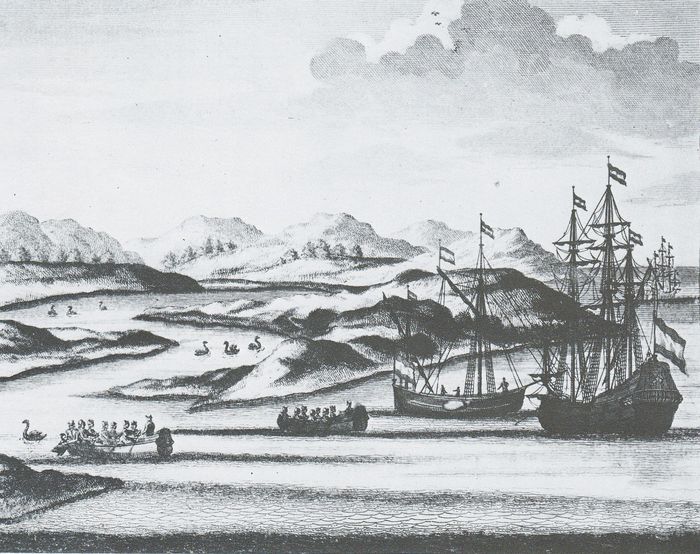
The Dordrecht captained by Frederik de Houtman also visited the coast late that year. (Jacob d'Edel, in another VOC ship, Amsterdam, was also on the same expedition.) The ships almost came to grief on what are now called the Houtman Abrolhos islands. The expedition landed on the coast in the Shark Bay area.
Another visitor in 1618 was Lenaert Jacobszoon who sailed the ship Mauritius past the North West Cape and named two water ways. The Supercargo on the ship was none other than Willem Janszoon, former Master of the Duyfken.
1619 the Amsterdam joined Dordrecht sailing along the coast near Fremantle. The two ships turned south going as far as present day Bunbury and then turned out to sea before heading north. There are conflicting reports about whether they saw Rottnest Island with one source stating they did and another saying the opposite. As they got further north J. De Edel sighted the Abrolhos Islands off Geraldton.
One source quotes the origin of the island's name as the Dutch or perhaps Portuguese words 'Abros vos olhos' or keep your eyes open.
1622 the Leeuwin (Lioness) sighted the southern cape that now bears the same name.
The Wapen van Hoorn captained by van Rosenbergh, almost went aground on an un-named part of the coast while sailing at night.
The Trial (also spelled Tryall in some sources) was wrecked (24th May 1622) between Barrow Island and the Monte Bellos at a site now known as Trial Rocks. Captain Brooks (or Brookes) abandoned the ship and most of its crew to their fate while he and 9 hand picked men sailed away to Java with the treasure the ship was carrying. Of the original crew of 143, only 46 escaped the sinking ship. Soon afterwards Brooks was at it again when the Moone foundered off the coast of England, but on that occasion the stolen treasure re-appeared after Brooks had been charged with the theft. (Another source says he was imprisoned for the 2 year duration of the trial but that the company ultimately dropped the case.)
The Trial (or Tryall) is the earliest ship known to have been wrecked in Australian waters. Its resting place was discovered in 1969 and the W.A. Museum investigated the site in 1971. Although there has been no conclusive proof that the wreck found is the Trial, it is generally accepted that the identification is correct.
1623 the Leyden (or Leijden) captained by Claes Hermanszoon, sailed through the waters of Shark Bay.
In the same year the ships Arnhem and Pera with J. Carstenszoon and W. van Coolsteerdt followed where the Duyfken had gone before, but they became separated and the Arnhem was blown to the west and sailed along the shore of a land that today bears her name - Arnhem land. Several members of the crew of the Arnhem were killed by natives on this voyage.
1626 Daniel Cock sails the Leijden along the coast from Zuytdorp Cliffs to Dirck Hartog Island but does not land.
1627 the ship Gulden Zeepaerdt (Golden Seahorse) with Francois Thijssen (Frans Thijsz) and Pieter Nuyts, sailed south of Cape Leeuwin across the Great Australian Bight almost as far as Spencer Gulf. The charts made during this voyage were still in use 175 years later.
The same year the Galias, Utrecht and Texel are almost wrecked on the Albrohos reefs.
J. van Roosenburgh (sailing in the Wapen Van Hoorn ) re-maps the coast near Shark Bay.
1628 the ship Vyanen (De Wit) sights the north west coast.
1629 the Batavia is wrecked (see more below).
1631 Willem Perregens in the Grootenbroeck sails between the Abrolhos Islands and the mainland finding a safe passage. The passage is recommended as an alternate route but is never used.
1635 Wijbrandt Geleynszoon in the Amsterdam charts part of the west coast.
1636 Gerrit Thomasz Pool led an expedition to the south land but Pool died early in the proceedings and the journey was abandoned shortly after making contact with Melville Island.
Pieter Pieterszoon with the ships Cleen Amsterdam and Wesell.
1642 Abel Jansen Tasman's first voyage takes place. This is the voyage he is best known for as he encountered Tasmania (or Van Diemen's Land as he named it after the Governor of Batavia) and New Zealand but he made a second voyage. (The ships used on this voyage were the Heemskerck and Zeehan.)
1644 Tasman, with the ships Limmen Zeemeeuw (or Zeemew) and Brak (or Bracq), sails from Cape York right along the northern coast of Australia down to Shark Bay before turning back to Batavia. Tasman seems to have made little attempt to describe or map the coast he passed and so this voyage is largely overlooked by historians. Had Tasman taken greater care with his observations it would have been the first great exploration of the northern coastline.
1648 Jan Janszoon in Leeuwerik maps part of the west coast.
1656 Vergulde Draeck wrecked. (see more below).
1657 The Vinck, captained by van Riebeeck sails from the Abrolhos to N.W. Cape.
1658 Samuel Volckersen with Waekende Boey (or Wakende Boei) and Emmeloort (or Emeloord) go in search of the De Vergulde Draeck and land on Rottnest. Abraham Leeman and thirteen other crewmen get separated from the ship and have to make their way back to Batavia. (See Leeman for more details.)
Jacob Pieterszoon in the Elburgh visits the Geographe Bay area and sees evidence of Aboriginal settlements.
An expedition by Peereboom is reported but we have no further details at this time.
1678 Jan van der Wall in the Vliegende Zwaan charts the area from North West Cape to Roebuck Bay.
1681 Captain Daniel in the London sails around the northern part of the Abrolhos Islands and the first English language description of this area is made.
1687 Captain Duquesne-Guitton in the L'Oiseau sights the west coast and sails near to the Swan River. This is the first recorded French contact with W.A.
1688 The first Englishman known to have landed on Australian soil was William Dampier aboard the Cygnet. Poor Captain Read is ignored by history.
1694 Ridderschap van Holland goes missing and is thought to be wrecked on the west coast. 326 people lost.
1696 Willem De Vlamingh with the ships Geelvinck, Nijptang and Weseltje charts the Perth region. Travels up the Swan River then goes north to Dirk Hartog Island and De Vlamingh replaces Hartog's pewter plate.
1699 William Dampier returns in the HMS Roebuck.
1712 The Zuytdorp (Captain Marinus Wijsvliet) is wrecked south of Shark Bay. (See more below).
1704 Maarten Van Delft, Andries Rooseboom, and Pieter Hendrikszoon in the Nieuw Holland, the Waijer, and the Vosschenbosch (Vissenbosch), chart the coast of Arnhem Land and have numerous contacts with Aborigines.
1727 Zeewijk (Steyns) is wrecked on the Abrolhos Islands. (see more below).
1756 Jean Etienne Gonzal and L. L. van Asschens in the Rijder and Buijs sail around the Gulf of Carpentaria and Cape Keer Weer. They have a number of contacts with the Aborigines. This appears to be the last Dutch expedition to Australia.
Lavienne Lodewijk van Assehens' voyage.
1768 Louis Antoine de Bougainville in the Boudeuse is stopped 100 kilometres from the Australian mainland by the Great Barrier Reef.
1770 Captain James Cook somewhat belatedly 'discoverers' Australia and sails along the east coast from Point Hicks (also called Point Everard) to Cape York. Cook never even sights the west coast. From then on Cook gets all the credit for discovering Australia despite that fact that he was almost 200 years late.
1771 Marion-Dufresne's voyage to Tasmania and New Zealand. While on the north island of New Zealand Dufresne and 25 of his crew were killed and eaten by Maoris.
Yves-Joseph de Kerguelen-Tr'arec leaves France with the Berryer and sails to Mauritius where he exchanged the ship for the smaller vessels Fortune and Gros Venture. The expedition's second in command (Saint Alo'rn) was given command of the Gross Venture. Bad weather separated the ships and the Fortune returned to France. Kerguelen started making all sorts of wild claims about his discoveries. He had in fact not landed on any of his claimed new lands and was greatly discredited when the Gros Ventre eventually turned up having completed their task of charting and landing on the new land they had found.
1772 Louis Fran'is Marie Aleno de Saint Alo'rn in the Gros Venture lands on Dirk Hartog Island and claims the land for France when he visits Shark Bay (March 31st). Allouran had sailed north from Cape Leeuwin right along the west coast before reaching Melville Island. Allouran died not long after returning to Mauritius (one source says he died in Timor). The ship Fortune commanded by Kerguelen had originally accompanied Allouarn but the ships were separated in a storm and the Fortune sailed back to the Isle of France.
1788 Just 5 days after the first fleet arrived at Sydney Cove, Jean-Francois de Galaup La P'ouse arrived with a group of scientists aboard La Boussole and L'Astrolabe. Perouse then set sail for the Friendly Islands but was never seen again. The remains of one of the French ships was found by Peter Dillon in 1827 on Vanikoro Island (Santa Cruz group of islands). Evidence was found that a vessel of some sort had been manufactured from the wreck and had sailed away but none of the survivors were ever seen again.
One item of particular note about this expedition was the application to join it by one Napoleon Bonaparte. His application was refused and the rest is history.
1791 George Vancouver discovers King George Sound on his way to the Americas. Claims the land on behalf of Britain.
1792 Antonie D Entrecasteaux's voyage with Recherche (Research) and Esperance (Hope) in search of La Perouse. The expedition came within only 70 miles of the wreck site. Just 2 months later D Entrecasteaux was dead from scurvy.
1795 Matthew Flinders came out to Port Jackson aboard the Reliance with George Bass.
1801-3 Flinders and Baudin's voyages.
1818 De Freycinet's expedition. (13 February 1820 L'Uranie was wrecked on the Falkland Islands)
P.P. King begins his voyages of exploration.
1824 Louis Isidore Duperrey.
1825 Hyacinthe de Bouganville (Louis Antoine de Bougainville's son)had 'most secret' orders from the French Government to report on defensive installations (Ie. to spy). This he did and sent a report that gave information about Sydney, Parramatta, Newcastle, Port Macquarie, Moreton Bay and Melville Island.
1826 Jules Sebastian Cesar Dumont d'Urville. (Served as Executive Officer on the 1824 Duperey expedition.) d'Urville's ship L'Astrolabe bore the same name as La P'ouse's ill fated ship.
1831 Cyrrille Laplace with the ship La Favorite.
1839 D'Urville again with L'Astrolabe and La Zelee.
It does seem strange, in retrospect, that the Indonesian people who visited the northern coast of Australia and who traded with the local Aborigines well before the land was discovered by the Europeans, never established any kind of permanent settlement on the coast.
The map of Australia's coastline took a very long time to be filled in. When the Americas were discovered it was a mere 50 years before the basic outline of both north and south America was known. It took some 250 years for the same thing to be known about Australia.
UNWILLING SETTLERS
While the arrival of the first English settlers is well documented, there were a number of rather unwilling settlers that arrived a long time before the English decided to settle W.A.
1629 : The Batavia
The story of the Batavia is quite well known but as one of the landmark events in the history of Western Australia we feel bound to include it in this guide.
The Batavia with the Dordrecht and Assendelft were sailing for the East Indies when they became separated. The Batavia sailed too far east and on the morning of June 4th 1629 struck Morning Reef near the Abrolhos Islands. The passengers, crew and some cargo was landed on two islands some distance from the ship. The Skipper (Ariaen Jacobsz) was responsible for the navigation of the ship but the man in charge of the cargo (the single most important thing on Dutch ships) was Francois Pelsaert, so he was technically in charge of the expedition.
During the voyage some of the crew planned to mutiny, seize the ship and kill everyone else aboard. The Batavia was deliberately separated from the other ships as part of the plot.
Pelsaert and the Skipper had a major falling out while the ship was at Cape Town and trouble had been brewing ever since. Most of the problems concerned a woman - Lucretia Jansz - who Jacobsz had tried to force his attentions on. When he was unsuccessful, he took up with Lucretia's maid and (on 14 May 1629) during a drunken rampage on board Lucretia was assaulted. Pelsaert was apparently too ill at the time to intervene.
After striking Morning Reef there was no immediate danger of the ship breaking up but some 180 passengers and crew were taken off and deposited on two islands. About 70 men remained aboard for some time until the ship seemed to be in grave danger. There was a great deal of drunkenness as discipline broke down.
Some cargo was brought to the islands but much food and drinking water was lost due to the drunken behaviour of many soldiers and crew.
Meanwhile Pelsaert took the ships boat and a number of crew along the coast searching for water.
No significant water was found and the party stopped overnight near Point Cloates. It is thought that this may have been the first time that any European spent the night on the mainland of the west coast - most explorers returning to their ships at night.
Pelsaert continued north to Batavia (Jakarta) arriving on the 5th of July. His actions in leaving the rest of the survivors stranded would later be greatly criticised.
After 4 days without water, people left on the islands began to die. Luckily for those who did survive there was a rainstorm and the empty water barrels were soon filled. Food in the form of fish, sea birds, eggs and seals was obtained from the island and shelters were constructed from sails washed ashore.
When the ship began to break up, the remaining sailors on board had to swim to the island. As many could not swim about 40 drowned while making the attempt.
Jeronymus Cornelisz (the supercargo captain) and his supporters started a reign of terror and murder that was to claim the lives of 125 men, women and children. The mutineers planned to take over the rescue ship when it arrived and become pirates.
The biggest problem for the mutineers was the soldiers and a plot was hatched to send them to another island in search of water and to abandon them there to die of thirst.
The soldiers were led Webbye Hayes who soon located a good source of water.
On the other island the nurders had started but some people escaped by paddling across to Hayes on improvised rafts.
These survivors warned Hayes of the danger and he organised a defensive structure and had his men improvise some weapons. Hayes' fortification is the first known European structure built in W.A.
Hayes and his men were outnumbered and out-gunned but they beat off no less than 4 attacks and even managed to capture Cornelisz in the process.
When Pelsaert returned on the Sardam on August 17th, there was a race between Hayes and the mutineers to reach him first The mutineers planned to board the rscue ship and take over. Hayes' men won the race and as the mutineers approached the ship they were faced with a line of primed muskets.
Pelsaert dealt out swift and bloody justice to the murderers - chopping off the hands of some before hanging them - but two men were spared.
On October 12 1629 the skipper of the Sardam and 4 others took a ships boat to search one of the islands for cargo from the Batavia but they were never seen again. The skipper was Jacop Jacopszoon and was accompanied by Pieter Pietersz, Ariaan Theuwissen and Cornelis Pieterszoon.
The small boat they were in was caught in a storm and is thought to have been carried out to sea. A search was mounted but no trace of them was found.
After 3 months of terror on the Abrolhos Islands, Wauter Loos nan Mastricht and Jan Pillegran De Bye van Brommel were marooned near the Hutt River mouth and although they had been party to the murders on the islands off shore, they were well provisioned and even left a boat. Although nothing more was ever heard from them there are indications that they may have survived and been taken in by local Aboriginal tribes.
Years later there were persistent reports of Aborigines in the area with blue eyes and fair hair so it is at least possible that the first unwilling settlers had in fact survived.
(Note: Pelsaert signed his name as 'Franco Pelsartt'.)
1656 : Vergulde Draek (Gilt Dragon)
After their ship was wrecked on April 28th near Pt. Leschenault, 7 crew sailed for Java in a long boat while 68 survivors (of a total compliment of 193) remained on shore. When rescuers returned no sign is found of the 68. The wreck was less than 100 miles north of what would become the colony at Swan River but for whatever reason the 68 people left on shore seem to have vanished. We have only recently heard a report that a settlement may have existed in the south west before the British colonists arrived but apart from the rumour there is no proof as yet that such a settlement ever existed.
Some sources quote that Abraham Leeman was one of those who sailed to Java but other sources make no mention of this. See Leeman for more details.
After the wreck site was located it was damaged and looted. This led to the Museum Amendment Act 1964 being passed to stop any further damage or theft from wreck sites. Despite the looting of this site subsequent expeditions have recovered a number of valuable artefacts.
For more information visit the GDRG website.
1656 : Geode Hoop (Good Hope)
3 sailors are lost in bush land while looking for the survivors from the Gilt Dragon and 8 more crew are dispatched from the ship to find them but their boat is overturned in the surf. Although no bodies are recovered no search is mounted and they are left to their fate.
1712 : Zuytdorp or Zuiddorp (South Town in English)
Between 40 and 150 people may have survived the ship wreck along the Zuytdorp Cliffs. Later exploration found significant numbers of artefacts from the ship that had been brought up on to the top of the cliffs by crew and passengers. Large fires had been lit and broken bottles, breech blocks and many other items were found.
Initially it was unknown which ship had been wrecked but the coins found in the area were dated no later than 1711.
Daisy Bates, travelled through the area in the early 1900s and she noticed the strong European features in many of the Aborigines living in that part of the West Australia.
She wrote in her book 'The passing of the Aborigines' : "Often I came upon a mixture of northern, eastern and south-western families gathered in one group and living amicably together, and, in one instance, a group of Bibbulmun in the centre of the Aggardee. I also found traces of types distinctly Dutch. When Pelsart [sic] marooned two white criminals on the mainland of Australia in 1627, these Dutchmen had probably been allowed to live with the natives, and it may, be that they and their progeny journeyed far along the river-highways, for I found these types as far out as the head-waters of the Gascoyne and the Murchison. There was no mistaking the flat heavy Dutch face, curly fair hair, and heavy stocky build."
Tom Pepper, a stockman working in the area, had found coins and other items at a campsite near the cliffs and years later (1954) when geologist, Phillip Playford visited the region, Pepper told him about the site he had found in 1927. Tom Brady and the Cramer brothers from Geraldton went diving in the sea where it was thought the ship may have struck and they found the remains of the ship. The sight they discovered was littered with silver coins. When the museum found out about the find they installed a watchman in a caravan at the top of the cliffs but one day when he was away picking up supplies the caravan was fire bombed and the Museum decided to withdraw the watchman. This was just what looters were waiting for and the carpet of silver coins soon vanished.
Work continues on this site and it is hoped that one day there will be some evidence found that gives a clue to the fate of the stranded crew and passengers.
1727 : Zeewick
At about 7:30pm the Zeewick (commanded by Jan Steyns) struck Half Moon Reef off the Abrolhos Islands on its way to Batavia. Initially the seas were too rough to launch the longboats but when they had calmed somewhat a camp was set up on a nearby island (Gun Island).
After the initial wreck 12 men set off for Batavia but are never seen again. Those that survived 9 long months on an island close to the wreck site built a boat from the remains of the ship and sailed to safety (although 6 more men died on the way north). The Zeewick was the last VOC ship to be lost on the West Australian coast. The wreck was discovered in 1952 and ten years later a cannon was raised and is now on display in Geraldton (Chapman Road.)
These are just some of the known survivors of ship wrecks along the West Australian coast. Most of these happened on a stretch of coast between Geraldton and Shark Bay.
In this area the Nanda people lived. The Nanda are unusual among all Aboriginal tribes. When British settlers arrived they found a tribe that was lighter skinned than other Aboriginies, where blue eyes were found in the population, blonde hair in adults was much more common as was baldness. This tribe was also taller than was the norm and their language differed considerably from that of surrounding tribes. There was also a tradition of building more permanent dwellings and of re-planting food plants. The tribe was much less concerned with the 'hunter-gatherer' style of living that other Aboriginal tribes.
George Grey wrote of the Aboriginal settlements he found near the entrance to the Murchison River:
'...two native villages or, as the men called them, towns. - the huts of which they were composed differed from those in southern districts, in being much larger, more strongly built, and very nicely plastered over the outside with clay, and clods of turf, so although now uninhabited, they were evidently intended for fixed places of residence. This again showed a marked difference between the habits of natives in this part of Australian and the south-western portions of the continent; for these superior huts, well-marked roads, deeply sunk wells, and extensive warran grounds, all spoke of a large and comparatively speaking, resident population.'
In 1848 Augustus Gregory was exploring the same general region and remarked after an encounter with local tribes that he was sure that they descended from mixed Aboriginal and European parentage.
All this points to the fact that survivors of shipwrecks did integrate with Aboriginal people and in effect,, became the first white settles not only on the West coast, but possibly in all of Australia.
Discoveries of European artefacts that pre-date British settlement, have been made up to 50 kilometres inland and there are persistent rumours of a Dutch village that was found, then lost somewhere in the outback.
The lost Dutch Village
In 1834 a letter appeared in the Leeds Mercury (25/Jan/1834) and an abridged version appeared in the South African Commercial Advertiser in July of the same year.
The author spoke of an expedition undertaken by Lt. Nixon who travelled inland from Raffles Bay and chanced across a fortified village of white skinned people who spoke Dutch (May 15th 1832). Their leader was named as van Baerle and the villagers are supposed to have been the descendants of shipwrecked passengers some 170 years before Nixon found the village.
The location was given as 18 degrees 30 minutes 14 seconds south and 132 degrees 25 minutes 30 seconds east. The location was some 300 miles from Raffles Bay. This puts the settlement somewhere in the Tanami Desert, south east of Lake Woods.
Despite attempts to verify this site no signs of a village have been found, but the question remains, why would anyone lie about it'
ABORIGINAL CONTRIBUTION TO EXPLORATION
Much is made of the conflict between settlers and the Aborigines but little is said of the significant contribution to the opening up of Australia by Aborigines who assisted many of the early settlers and explorers.
We have already touched on this subject on other pages by mentioning that without Aboriginal stockmen, much of the settlement of the northern areas of the state would not have been able to proceed.
Aborigines helped early settlers to find food and most importantly to find water. One outstanding contribution to European settlement was made by Tommy Windich.
John Forrest wrote of Tommy:
'I have never known any white man equal as a companion in the bush to Tommy Windich, and I have had a long and varied experience. It is impossible for them [Speaking of Tommy Windich and Tommy Pierre] to lose themselves; a horse could not stray without their being able to find it; they at once noted everything that they saw, such as the flight of birds, track of Aboriginals and wild animals, emu footprints and other minute details with wonderful accuracy, and could readily find water if there was any in existence to be found. My companion was a perfect wonder in many ways, and I cannot speak too highly of him''
When Tommy died John Forrest wrote:
'This faithful and intelligent native passed away still in the field of exploration as he had been for so many years. He was still quite a young man and had been intimately connected with every exploration in this Colony for the last ten or twelve years. He accompanied Mr. Hunt, Mr. Alexander Forrest and myself. Twice he crossed with me from Perth to Adelaide and took a very prominent part in these expeditions. He possessed great knowledge of the interior, and I feel that he was the most experienced and best bushman in the colony.'
History often forgets to give proper credit to the Aboriginal trackers and Co-explorers. People like Tommy Windich of the Njaki-Njaki people should also be given their rightful place in our history.
A number of explorers commented on the Aborigine's ability to mimic European speech. Aboriginal people learned to speak English quite quickly and had a natural affinity for languages. This was probably due to the number of differing dialects across the tribes and the need for communication in differing ways that already pre-dated European settlement.
|



|
Become a supporter of this website for just $5 a month
|