DESCRIPTION
As it developed, Mundaring became a popular weekend retreat for city businessmen who built small cottages. It was also said that the air was cleaner than down on the coastal plain
(it certainly is today) and Mundaring then became a health retreat.
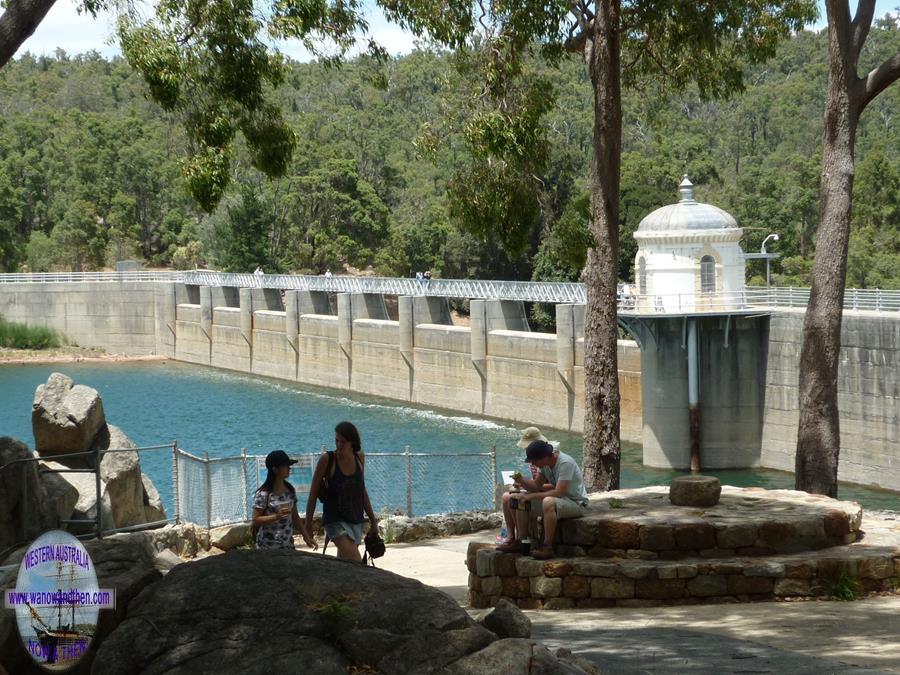
When the weir was completed, that too became a tourist attraction. At the time it was the highest overflow dam in the world and when it finally overflowed in 1903, large crowds gathered
to watch the spectacle.
In 1947 the weir wall was raised by 32 feet giving the dam greater storage capacity. 8 years later adjustable steel gates further increased the amount of water that could be stored.
Unfortunately with the current drought conditions we have been experiencing, it may be a long time before we ever see water flowing over the wall again.
HISTORY
Ensign Robert Dale was one of the first to explore this area in 1829. The Helena River is said to
be named after his sister. James Drummond took up land along the river in 1831 but moved on to Toodyay. The first permanent resident appears to have been
Peter Gugeri who started growing grapes in 1882.
The townsite was surveyed in 1898 and early settlement in the area was centred around the viniculture and timber industries.
Located in the hills east of Perth, Mundaring is set amid stands of eucalyptus. Nearby Mundaring Weir was opened in 1903 and used to supply the eastern goldfields with drinking water.
The pipeline to Kalgoorlie was opened in 1902 and the first water took 10 months to reach its destination (10th January 1903). The engineer
(Charles O'Coonnor) responsible for the project shot himself shortly before the water
started to flow.
Mundaring is an Aboriginal word meaning 'high place on a high place'. It was originally known as Greenmount and was changed in 1934. It was not declared a shire until 1961.
While towns sprang up all around the area, Mundaring itself was very slow to get started.
Chipper's Leap is a grey granite rock standing near the top of Greenmount Hill. On February 2nd 1832 John Chipper and Reuben Beacham set out from Perth heading
to York with a load of provisions on a horse and dray. As they neared the top of the hill they were ambushed by a group of Aborigines and Chipper was hit by two spears
as he attempted to get away. In desperation he leaped off a large granite boulder falling 25 feet. Tumbling down the hill he managed to escape but Beacham was not so lucky. A number of
Aborigines were captured and hung. John Chipper recovered living to the age of 71.
Peter Anthony Gugeri was one of the first to recognise the areas potential for viniculture and he established St. Bernard vineyard in 1882 after having some success growing grapes
near the Swan River.
In 1884 he wine won first prize at the Royal Show - which was still heal at Guildford at that time. By 1888 he controlled about 30% of the state's wine and spirit trade. When the railway
arrived the stopping point was named Gugeri's in recognition of his achievements. Gugeri later sold out to M. H. Jacoby who renamed the vineyard Mundaring after finding that this was
the native name for the area.
A sawmill was set up on land adjoining the vineyard and it was here that a small settlement first started to grow. The Mundaring Weir project brought a large number of workers into the
area and by 1902 a solid community had been established.
TALL TALES AND TRUE
Merde!
Charles Lauffer had lived in the area for a long time and was well known and liked. Locals were shocked when he was murdered by a group of French picnickers.
5 men (2 with police records) and three women (all prostitutes) had come up to the hills and had spent the day eating and drinking at various establishments.
In the afternoon they had approached Charles Lauffer wanting to buy a single bottle of wine. As he only had a gallon license he could not sell a single bottle and an
argument developed and rapidly became violent. One of the Frenchmen pulled out a revolver and shot Lauffer twice killing him instantly.
When the local Constable arrived to arrest the group they showed no remorse and even when waiting for the train to arrive to take them to the lock up at Guildford
they were laughing and joking among themselves.
All 8 were charged and tried for murder and 6 were found guilty and sentenced to hang. On appeal only the man who pulled the trigger (Maillat) was convicted and
he was hanged on April 21st 1903.
Railway troubles.
The only railway tunnel constructed in the state (at that time - 1896) was at Swan View. It was found to be somewhat unstable and had to be lined with bricks.
When put into service it was quickly found to have serious ventilation problems and crews were often overcome by smoke. On some occasions drivers fell from the
engine and one was severely injured. Protests from railway staff were ignored until the 1940s when the crew of one train all passed out.
The accident happened on November 4th 1942 and involved a double engined goods train pulling 431 tonnes. The driver of one engine managed to shut off power
before he passed out but the other driver passed out before he could take action. As the train began to slip backwards the engine still under power switched into reverse
and the train hurtled back down the track at considerable speed.
The runaway train passed Sawn View station doing an estimated 80 kilometres and hour and was directed off the main line into a dead-end that had been constructed
in case of such an event.
As the rear wagons hit first there was a cushioning effect on the front of the train where the crews were located. This saved three men from serious injury but sadly
one of the engine drivers had succumbed to smoke while still in the tunnel and had died.
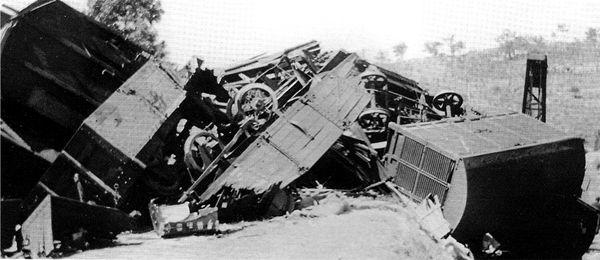
Finally after a tragedy that should never have occurred the railway management acted and the tunnel was abandoned in favour of a cutting that was made in 1945.
More problems for the railway took place on the Jane Brook line in July 1896. A mixed goods train (with one passenger car) suffered a break in a coupling not long after a passenger
train going down to Midland had passed by.
The runaway carriages hurtled down the line after the passenger train and after a telegraph from the Station Master at Parkerville the passenger train was shunted onto a siding, avoiding
a complete disaster.
Unfortunately for the two passengers and seven horses on the runaway, there was no way of stopping the headlong plunge and at an estimated speed on 120mph the train left the rails
and smashed to pieces.
James Morgan (the newly appointed Forest Ranger) was killed but Faulkner (the other passenger) had a miraculous escape.
He was found wedged between two rocks with a metal spar driven 3 metres into the ground just inches from his head.
VIDEO
PROBLEM PLAYING THESE ON FIREFOX?
Turn off Enhanced Tracking Protection
Click the shield icon left of the URL near the top left
Slide Advanced Tracking Protection to OFF
(C) vigor3d YouTube channel.
OTHER INFORMATION
ATTRACTIONS
Mundaring Weir, John Forrest National Park, C.Y. O'Connor Museum, Kookaburra Outdoor Cinema, The Lavender Patch, Lake Leschenaultia, Wineries.
BUILDINGS OF NOTE
Mundaring Hotel, Weir Hotel, Pump house.
ELECTORAL ZONES
State : Mundaring
Federal : Pearce
OTHER INFO.
Postcode : 6073
Local Government : Shire of Mundaring
PHOTOS
Click on a thumbnail to see full sized picture.
Please note that using the https url will cause the photos not to show. To show photos use the standard http url.