|
|
|||

|

|
|

|
|
|
|||
|
|
CUBALLING
GPS 32 49 16 S 117 10 35 E
|
|||||||||
| ||||||||||
|
|
||||||||||
|
WE NEED YOUR SUPPORT. |
||||||||||


|
|
|
|
|
STATISTICS
SERVICES
CARAVAN PARKS
HOTEL / MOTEL / B AND B
|
DESCRIPTION
The town of Cuballing has a population of approximately 300, and the whole Shire is approximately 600.
The Cuballing Hall was been re-painted inside and outside and restored to its original beauty.
The town seems to reside in the distant past and visitors may feel like they have stepped back to the 1930s. The town dates back to the 1880s and despite never developing like its near neighbour Narrogin, it manages to survive.
The major attraction in the area is the Dryandra State Forest which is one of the last remaining pockets of woodland in the wheat belt. This area will help people to understand what the wheat belt was like before it was cleared for cropping.
In the forest there are still colonies of woylie, tammar and numbat plus over 100 species of birds. A guided tour of the area is available by tuning your radio to 100FM.
HISTORY
The name Cuballing is taken from 'Cubballing Pool' which was discovered by John Forrest in 1870. The current spelling was adopted in 1899 when the town site was gazetted.
The Great Southern Railway was completed in 1889 and with this precious link to civilisation came a rush of settlers.
At this time it was hoped that Cuballing would be picked to become the rail centre, with hopes of expanding it into a large town. A period of 'wooing' government ministers resulted in forged signatures on petitions, invitations to inspect sites combined with long liquid lunches. (Nothing has changed much has it') However in 1906 Narrogin was chosen mainly due to the fact that the line from Collie to Narrogin had already been started and that water was more readily available. Once it became apparent that the railhead was to be established in Narrogin there was a steady decline in people coming to settle in the area. The Great Depression in the 1930's did not help in attracting people and many farming families found they had to leave their farms and seek a living elsewhere.
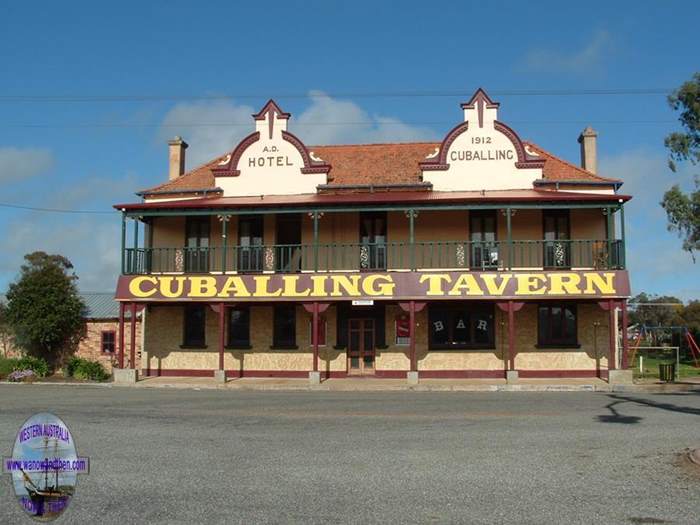
The first hotel was built in 1891 but it was destroyed in 1906 and the first floor of the current hotel was then constructed with the second storey being added in 1912.
It is recorded that by 1889 there were eleven buildings, including the hotel, although other sources say the hotel dates from 1891. The first school opened in 1895 and by 1898 the first brick and stone town hall was completed.
The Cuballing School that opened in 1895 had an enrolment of 6 boys and 14 girls. The school reached a peak of 59 pupils in 1913, then closed due to lack of attendance in 1929.
The Cuballing Road Board was formed in 1903 and held its first meeting on January 24th. The District Hall was originally used as their office.
The Methodist Church was constructed in 1904 and the town began to grow slowly as more buildings were added.
In 1906 a grand dance and concert was held in April to celebrate the opening of the Popanyinning Hotel.
The first Post Office served the district until just after 1905, when a new brick building was erected.
Records show that there were two butcher shops, the Cuballing Hall, Post Office, Cuballing Coffee Palace, WA Bank, National Australia Bank, two blacksmiths, Church of England, Methodist Church, a boarding house and the Hotel. All buildings at that time appear to have been made of bricks from the local firm of Davey Bros.
The Aldenga School opened with 12 pupils, and then closed in 1928. It was then reopened as Stratherne School and closed in 1936.
The Popanyinning School opened in 1905 with 23 students and closed in 1973.
Wardering School opened, then closed in 1911. The Nebrikinning School opened in 1907 and continued until 1940.
In 1908 the East Popanyinning School opened in the Church Hall and closed in 1913 due to low attendance. It was reopened in 1918, and in January 1938 the school was burnt down. The school was quickly replaced and reopened in April 1938, then finally closed for good in 1946.
The Yornaning School opened in 1909 and maintained an average of 20 pupils until it closed in 1943.
In 1910 the West Popanyinning School began, but closed only a year later in 1911. The school was then moved to a more central position and became the Lol Gray Soak School, which opened in 1912.
The Woodlands School opened, and then closed in 1945.
St. Peters Church of England was consecrated in 1911 and the following year a second level was added to the Hotel.
The Lol Gray Soak School opened, then closed in 1936. It was relocated to Dryandra and reopened as Lol Gray School, then in 1940 the name was changed to Dryandra School, closing in 1950.
1921 - A granite War Memorial was unveiled and still holds a place of importance in the Main Street.
1923 - The Commodine School opened, and closed in 1934. It was reopened in 1935, then closed forever in February 1936.
1931 - The Cuballing School reopened and continued to function until 1946, closing with 20 pupils.
1978 - The Popanyinning Hotel burnt down in September and it has never been replaced.
1979 - The new Shire Office was built, which left the Cuballing District Hall empty until the Cuballing Branch of CWA took over the building as their Centre.
1993 - The old Post Office was closed and is now situated at the Roadhouse on the Great Southern Highway.
1998 - Shire children travel to primary or high school by bus to either Narrogin or Pingelly.
TALL TALES AND TRUE
Shotguns and Ghosts
Could it be true in this quiet little town that one of the publicans of the old hotel once went crazy and lined up three people (Candy, Henderson and Davey) against the wall threatening to shoot them?
The story says they escaped through a window and were shot at while running to safety in the nearby bank. What happened after this we haven't managed to find out.
Another story about the hotel tells of the ghost of Ted Leighton. He is said to make his appearance in winter and to cause trouble if ever any part of the hotel is changed or modified. Ted lived in the area and was yardman at the hotel before he died. Strange occurrences like gas bottles being turned on, kegs rolling around, doors slamming and the ice machine being turned off are attributed to Ted's ghost.
The Tree
A large white gum stands at the intersection of roads heading for Wickepin and Yealering 4 kilometres east of Cuballing. It was once the place that mail and parcels were left for local farmers to collect on their way to town. The following verse was written about this once important location:
East of Cuballing there is a tree a knotty gnarled old white gum
MAP
VIDEO
PROBLEM PLAYING THESE ON FIREFOX?
OTHER INFORMATION
ATTRACTIONS
Yornaning Dam, Dryandra Woodland,
BUILDINGS OF NOTE
Post Office, Hall, Hotel.
ELECTORAL ZONES
State : Wagin Federal : O'Connor
OTHER INFO.
Postcode : 6311 Local Government : Shire of Cuballing
PHOTOS
Click on a thumbnail to see full sized picture.
|




|
Become a supporter of this website for just $5 a month
|