DESCRIPTION
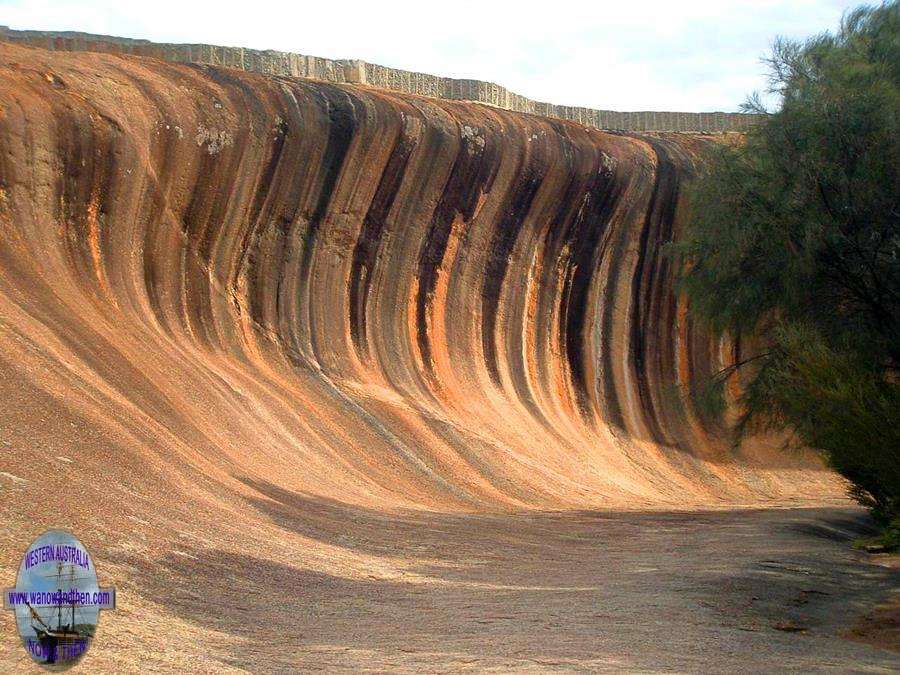
Hyden is a fairly nondescript wheat belt town made famous by its proximity to Wave Rock.
The rock was 'discovered' by the world thanks to a photograph in an issue of National Geographic in 1967. Over 100,000 tourists a year visit the rock and account for about
15% of the income generated in the area.
The rather ugly retaining wall on top of the rock was built in the 1950s to channel water to a nearby reservoir. Fees are charged to visit the rock.
Aboriginal art was found in a nearby cave but there was no sign of Aboriginal people in the area when white settlers first arrived.
Mulka's Cave - as it is now known - was said to belong to an Aborigine who had been
cast out of his tribe because the union of his parents was against tribal law. Mulka is said to have been cross eyed and could not hunt with a spear because of his poor vision.
Cast out of his tribe and unable to hunt, Mulka began to eat the tribe's children and when his mother confronted him he killed her and fled. The tribe hunted him down and killed
him near the present site of Dumbleyung. Not being worthy of proper burial his corpse was dragged to an ant hill and left to be eaten by the ants.
The area then became taboo to the Aborigines who moved elsewhere.
Granite Woodlands Discovery Trail.
This trail leads you from Hyden to Norseman over 300 kilometres of mostly unsealed roads. The trail is suitable for most vehicles
including those towing caravans. There are 16 designated stopping points along the trail.
HISTORY
The area was settled in the mid 1920s and once was totally reliant on wheat and sheep farming. Rock formations close to town are now drawing more and more tourists to the area.
The town's name is supposed to come from a sandalwood cutter called Hyde. (Another source suggests a German prospector Carl Heiden as the source of the name.)
Hyden is the most recent of the towns in the central wheat belt. Farming didn't start until 1922 and the railway only arrived in 1932 when the townsite was finally gazetted.
TALL TALES AND TRUE
No information for this section yet. If you know of something we can add here please contact us and let us know.
VIDEO
PROBLEM PLAYING THESE ON FIREFOX?
Turn off Enhanced Tracking Protection
Click the shield icon left of the URL near the top left
Slide Advanced Tracking Protection to OFF
Check out our other VIDEOS
NEW **** CLICKABLE VIDEO MAPS **** NEW
OTHER INFORMATION
ATTRACTIONS
Wave Rock, Wildlife Park, The lace Place, Bate's Cave,
Military Miniatures,
Hippos Yawn, The Humps,
Gnamma Hole, King Rocks, Mulka's Cave, Rabbit proof fence, Stargate Observatory, Lake Magic, Hyden Dam.
More information about Hyden.
BUILDINGS OF NOTE
Unknown.
ELECTORAL ZONES
State : Wagin
Federal : O'Connor
OTHER INFO.
Postcode : 6359
Local Government : Shire of Kondinin
PHOTOS
Sadly something has disabled these photo sections on our website.
We don't know what it is or how to fix it.
Aplolgies for the inconvenience. We will work on finding a way round it.
.