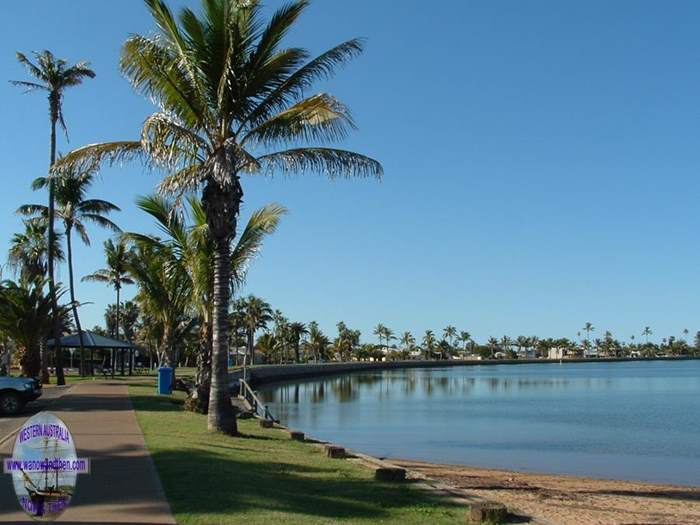
The climate is probably about the best of any town in W.A. The winter is relatively mild and the strong south westerly winds that blow most days during the
summer keep the temperature down, so that it is usually cooler here than Geraldton 500km to the south and much cooler than
Exmouth which is only just over 250km north.
Having said that, Carnarvon can be intermittently hit by flooding and cyclones with the most recent damage being done by a large flood in 2010
and by a cyclone in 2015.
Carnarvon is the true gateway to the tropical north in W.A. Shopping isn't too bad with a choice of Woolworths and IGA supermarkets in town. It is an
interesting stop on the way to the 'top end'. There used to be good campsites not too far away at Miaboolya Beach north of town and
Rocky Pool to the east but the shire is becoming unfriendly to campers who do not want to stay in caravan parks.
Bush Bay 30km south is no longer a free site and Blowholes (Quobba) is too expensive
for a beach campsite.
One note of caution about Quobba is the occurrence of freak waves known as king waves. More than 30 people have lost their lives along this coast after
ignoring the warning signs that are posted in the main danger areas.
Bananas are the most dominant (and visible) fruit in the area and the credit for growing the first commercial crop goes to Jack Buzolic (*) who
began commercial harvesting in 1930. Australia produces in the vicinity of 300,000 tonnes of bananas a year (weather permitting) and of this the
Carnarvon plantations only produce about 4,000 tonnes. Banana prices fluctuate wildly depending on demand and when cyclones hit Queensland and destroy crops
there, Carnarvon growers can see prices increase as much as 1800%.
The next most numerous fruit type found growing near Carnarvon is the Kensington Pride Mango. Mango season starts around Christmas time and many of the
growers sell direct to the public. Although Kensington Pride are probably the best known variety, there are several other types being grown that are worth trying.
70% of WA's winter vegetable needs are supplied by Carnarvon and the 176 plantations supply over 30,000 tones of fruit and vegetables each year.
There is also a salt works at Lake Mcleod north of the town which produces over 1.5 million tonnes of salt a year.
There is a local prawn processing factory but we can't see why they bother to sell to the public because prices at the local Woolworths are usually much cheaper.
(*) - One source states that Frank Wise was the first to bring banana suckers to Carnarvon from Queensland. Frank Wise came from Queensland as an agricultural advisor
and entered WA parliament in 1933 then became premier of the state in 1945.
HISTORY
The earliest Europeans to glimpse the coastline in this part of the world were almost certainly Dutch. The first confirmed landing was on Dirk Hartog Island
(by Dirk Hartog no less!). This was way back in 1616. Hartog named the area Eendrachsland after his ship Eendracht.
Sir George Grey discovered the Gascoyne River in 1839 and the island at the river's mouth he named Babbage Island. Grey's exploration was met with
one disaster after another and after losing all his boats he and his party had to walk all the way back to Perth.
Carnarvon takes it's name from Lord Carnarvon (
Henry Howard Molyneux
), British Secretary of State for the Colonies 1866-7 and 1874-78.
The Aboriginal name for the area was kuwinywardu (Kow-win-wordo), meaning neck of water.
By 1876 there were already settlers in the area when Brown, Brockman and Monger drove 4000 sheep from York and established sheep stations in the vicinity.
A townsite was gazetted in January 1883 and in 1886 the first land in town was sold.
The need for a jetty was quickly apparent and the first one was constructed in 1889. A better structure followed in 1900 and 9 years later a tramway was added
to facilitate movement of goods and passengers the town that was some distance away.
The Gascoyne River (that flows mostly underground) is 865km long. It is the main source of irrigation for the area and during
exceptionally heavy rains it can flow over the main road bridge heading north.
The town suffered major floods in 1883, 1897, 1905, 1907 and 1909 and a protective bulwark known as the Fascine was completed in 1913. The fascine (a timber retaining
wall) is said to be one of only two of its type in he world. Even after this barrier was constructed floods continued to visit Carnarvon from time to time. In 1961
over 2,000 people were evacuated first to 40 Mile Tank and then to Perth when the river burst its banks. Another smaller flood caused significant damage in 1980.
Not all of the town's history is covered with the glory of triumph over adversity. The treatment of the local Aboriginal people was deplorable in the early years.
In the book 'The Passing of the Aborigines' Daisy Bates wrote:
'Dorre and Bernier Islands: there is not, in all my sad sojourn among the last sad people of the primitive Australian race, a memory one-half so tragic or so
harrowing, or a name that conjures up such a deplorable picture of misery and horror unalleviated, as these two grim and barren islands of the West Australian
coast that for a period, mercifully brief, were the tombs of the living dead...
...When I landed on Bernier Island in November 1910, there were only fifteen men left alive there, but I counted thirty eight graves.
There were seventy-seven women on Dorre Island, many of them bed-ridden. I dared not count the graves there. A frightful sight it was to see grey-headed women,
their faces and limbs repulsive in disease, but an even more frightful sight to see the young-and there were children among them.
The first fruit trees brought to the area were orange trees brought in by Mr. Mcleod in 1908. Since then fruit growing has been gradually developed in the area
and is now worth more than 18 million dollars a year.
In 1922 an agricultural research station was opened, but it was not until the 1940s when tropical fruit started to be commercially grown, that the area's fruit
industry really started to take off. Today there are around 70 plantations operating near the town. Many sell fruit direct to the public and the prices are low
and the quality (usually) high.
In 1964, NASA opened a tracking station near the town. The words 'One small step for man, one giant leap for mankind' were actually broadcast to the world from
this tracking station as Neil Armstrong became the first man to place his foot on the moon. The tracking station was later converted into an OTC site for phone
communications. Today it just sits rusting up on top of a sand ridge, a monument to man's early exploration of space.
The tracking station at Carnarvon was not the first connection with the American space program. A tracking station at Muchea (near Perth) was the first place
where, in February 1962, astronaut John Glenn first spoke to comm. tech. Gerry O'Connor.
The Gribble Controversy.
Rev. John Brown Gribble came to the Gascoyne as a Missionary. His task was to establish a mission and Christianise the local Aborigines but on his rounds to
various pastoral stations he was horrified at the abuses carried out by the settlers on the Aborigines.
Gribble quickly fell out of favour with the white population (although he did have some supporters) and a petition was raised to get rid of the meddling outsider.
When Gribble attended local meetings he was shouted down, but this was not a man to be trifled with. This was the same Gribble who, when the Kelly gang held up
the town of Jerilderie, had gone to Ned Kelly and demanded that his stolen watch be returned.
Gribble responded to the local antagonism by publishing a booklet describing in some detail the abuses that were taking place and this made its way into the
newspapers in Perth. Gribble asserted that the native labour system bordered on slavery and he named names!
An incident then took place aboard the S.S. Natal where Gribble (rightly) feared that his life was in grave danger. He reported the incident on arrival in Perth
and wanted to take legal action but the vested interests of wealthy pastoralists saw to it that no charges were ever brought.
Gribble went as far as making a complaint about the matter, and the Governor, to the Colonial Secretary, but still he was ignored.
The establishment in Perth did its best to rid the colony of Gribble but he had genuine public support. In a sneak attack, the Bishop's Commissary withdrew
Gribble's missionary license (July 1 1886) and closed the Gascoyne Mission while Gribble was away seeking support in the eastern states. Not to be outdone
Gribble was granted a general preaching license by the Primate of the church who then sent him on a speaking tour for 3 months.
By now excerpts from Gribble's booklet had reached the Melbourne press and this further enraged the Perth squattocracy. The West Australian Newspaper (a mouth
piece for the establishment) wrote:
'one of whom [gribble] without exaggeration, we might designate as a lying, canting, humbug.'
On the other hand, the Fremantle Herald found Gribble's account, 'a story equal in atrocity and horror to any told in the worst days of American slavery.'
Gribble took out a writ of Libel against the paper and sued for 10,000 pounds. Despite having the support of Chief Justice Onslow the result was never in doubt.
The establishment closed ranks and Gribble lost the case. Now bankrupt he left Western Australia and for a time was employed by the Aboriginal Protection Society
of New South Wales. He later returned to missionary work but was a broken man. He died aged only 45 in 1893.
Gribble was what we would call today, a whistleblower and he suffered the same fate as many brave men who stand up for what is right and just. On his tombstone are the words;
"Black fellow's friend"
The affair, however, did not end there.
Chief Justice Onslow and
Governor Broome had a major falling out over Onslow's
support for Gribble and the Chief Justice was suspended after making a public
statement that he refused to withdraw. (Governor Broome had in fact suppressed information from Lt. Col. E. F. Angelo, the Government Resident at
Roebourne, that corroborated Gribble's accusations.)
Onslow had public support and a protest march through the streets of Perth burned an effigy of the Governor.
John Hogan (a member of the Legislative Council) called the West Australian Newspaper a
'reptile sheet' and an 'embodiment of lies, distortion, snobbery and low journalism.'
The newspaper responded by writing some unfavourable comments about Hogan and another libel case ensued. Meanwhile the Privy Council had re-instated Justice
Onslow and on this occasion the paper was found guilty of libel and fined 800 pounds.
Granny Glasgow
Granny Glasgow (nee McGuire) is said to have delivered over 700 babies.
She was a long term resident of Carnarvon who outlasted 32 doctors and legend says she took
no holidays for 40 years!
Her first husband was a policeman named King who was locally called "The King of the West". It is said he was speared by Aborigines.
The Granny Glasgow Education and Care centre in Carnarvon was named in her honour.
TALL TALES AND TRUE
The Mad 8.
A group of gun (expert) shearers was put together as a team to see how well they could perform. When working at Williambury Station they sheared 9167 sheep in a
40 hour working week, a world record that we believe may never have been broken.
Prawn feast
In 1903 some research was being done into the types and numbers of fish available for harvest in local waters. The research vessel was working off Dorre Island
when on one run it lowered its nets and came to a complete stand still. The captain thought he had run afoul of an uncharted reef so imagine his surprise when
the nets came up full of huge prawns. There was nowhere for the catch to be stored so they were taken to Carnarvon and given out free to the lucky residents.
Even though it was known that good catches of prawns could be taken it was not until 1961 that the prawning industry got established.
Kingsford Smith goes trucking.
Charles Kingsford Smith with his partner,
Keith Anderson purchased a truck and formed the Gascoyne Transport Company. Smith ran a mail run from Carnarvon to Bangemall (near
Mount Augustus.)
MAP
VIDEO
PROBLEM PLAYING THESE ON FIREFOX?
Turn off Enhanced Tracking Protection
Click the shield icon left of the URL near the top left
Slide Advanced Tracking Protection to OFF
OTHER INFORMATION
ATTRACTIONS
Blowholes,
Rocky Pool,
Boat Harbour,
Miaboolya Beach,
One Mile Jetty,
Pelican Point,
Bush Bay,
Bibawarra Bore,
The plantations,
Chinaman's Pool,
Dwyer's Leap,
Lighthouse Keeper's Cottage Museum,
Prawning factory,
Tracking Station Space Museum,
HMAS Sydney Memorial,
Shearer's Hall of Fame,
Railway Station Museum.
BUILDINGS OF NOTE
Hotels, Churches, Old post office, OTC station, Lighthouse keeper's house 1896, St. George's Church 1907, St. Mary Star of the Sea 1935.
BANANAS - QUICK FACTS
The banana is a herb that belongs to the same family as lilies and orchids.
The name comes from the Arabic language and means finger.
Each banana plant only produces one hand of bananas.
There are at least 400 different varieties of banana.
Do not refrigerate bananas.
There are claims that bananas can:
Help you feel happier
Help with PMS
Assist with managing anemia
Reduce blood pressure
Help with alertness
Relieve constipation
Mixed with milk and honey make a good hangover cure
Relieve heartburn
Reduce morning sickness
Reduce insect bite irritation by rubbing the inside of the skin of the affected area
May assist with reducing stomach ulcers
Help with the effects of nicotine withdrawal
Cure warts by sticking the banana skin (inside area) to the wart with elastoplast
reduce stress and strokes.
Bananas also have four times the protein, twice the carbohydrate, three times the phosphorus, five times the vitamin A and iron, and twice the other vitamins and minerals of an apple.
BIBBAWARRA BORE - QUICK FACTS
The bore was located in 1903 while test drilling for coal.
It is located 16 km north of Carnarvon on Bibbawarra Road.
The hot artesian water wells up from a depth of 914 metres.
The flow rate has been measured at over 97,000 litres an hour.
The water temperature is 65C so care should be taken when near the bore.
Fish thrive in the reed pond near the bore despite the high temperature.
The trough (built in 1940) that used to extend from the bore was 180 metres long and was the longest of its type in the Southern Hemisphere.
The bore was closed in 2010 and no longer flows.
ONE MILE JETTY - QUICK FACTS
Construction began in 1897 and was completed in 1904.
The jetty is 1.6 kilometres long.
The jetty was no longer used for shipping in 1976 when the small boat harbour was constructed.
Restoration of the jetty began in 1998.
The jetty was a good spot to catch mulloway, tailor and bream.
The jetty was badly damaged in tropical cyclone Seroja and engineers recommended the removal of all but the first 400m of the structure.